

Dead stock is inventory unlikely to sell or be used before expiry, obsolescence, or a lasting shift in demand. Reducing dead stock in pharmaceutical distribution starts with matching replenishment to expected demand and actual consumption, while keeping stock movements, supplier lead times, and expiry dates visible. This makes purchasing decisions more responsive than simply repeating past orders.
It is understandable to hold extra stock when demand changes and supply delays disrupt replenishment. But stock that sits too long ties up working capital and can become a loss, especially when medicines have limited shelf lives.
This article explains how historical and real-time inventory data support better reorder planning, why supplier lead-time visibility matters, and how batch and expiry tracking helps distributors act on slow-moving stock. These practices work together to reduce avoidable over-ordering while keeping inventory decisions grounded in demand.
Key Takeaways
- Use historical sales alongside current inventory and consumption data to spot demand changes before they turn into excess orders.
- Factor supplier lead times and possible disruptions into replenishment decisions so buffer stock reflects actual supply risk.
- Track batches, product movement, and expiry dates to prioritize FEFO rotation and identify stock that needs attention.
- Set reorder levels around forecast demand, consumption, and incoming stock rather than relying on fixed order habits.
- Define dead stock by how slowly items move and whether they can still be sold or used before expiry or obsolescence.
Demand forecasting using historical and real-time inventory data
For Kenyan distributors, useful forecasting connects sales history with current inventory movements. The aim is to replenish for likely demand, not simply repeat the previous order.
Historical and Real-Time Inventory Inputs
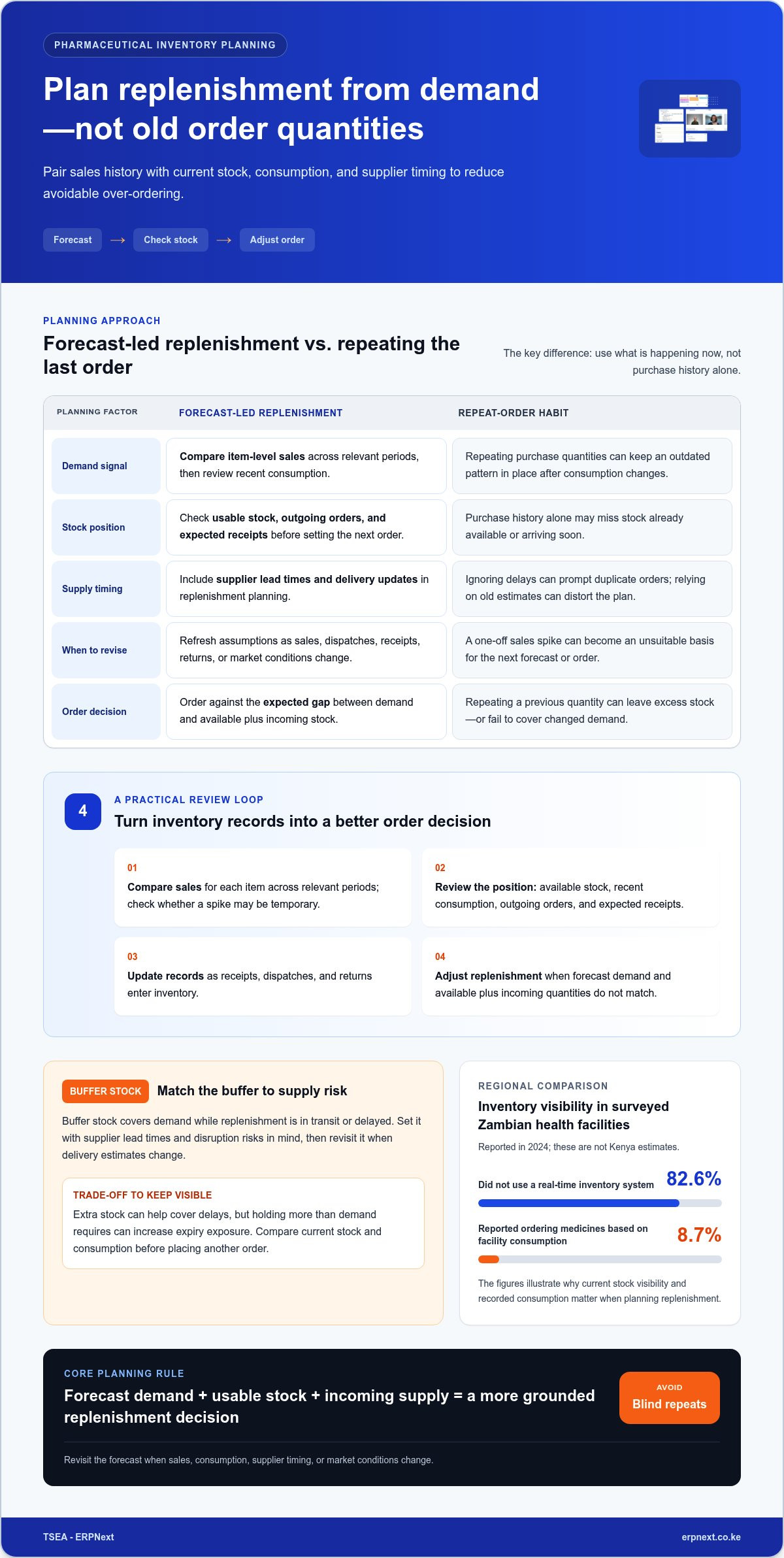
Historical and real-time inventory inputs combine past sales, current stock, and recent movements to estimate future demand. A single sales spike can distort the next forecast if it reflects a temporary event. Compare item-level sales across relevant periods, then review available stock and outgoing orders before adjusting planned replenishment.
Update the forecast as receipts, dispatches, and returns enter inventory records. In surveyed Zambian health facilities, 82.6% did not use a real-time inventory system in 2024. That finding is a regional comparison, not a Kenya estimate, but it shows why current stock visibility matters: stale records can make an apparently accurate forecast produce an unsuitable order.
Consumption-Based Ordering
Consumption-based ordering uses actual quantities issued or sold to guide replenishment, while forecasting estimates upcoming needs. Simply repeating purchase quantities can preserve an outdated pattern after consumption changes. Compare recent consumption with usable stock and incoming orders, then base the next order on the expected gap.
In surveyed Zambian health facilities, 8.7% reported ordering medicines based on facility consumption in 2024. This is not a Kenya statistic; it illustrates the role of recorded consumption in planning. For a distributor, item-level sales and dispatch records give a stronger demand signal than purchase history alone.
Inventory Optimization Through Forecasting
Forecast-led inventory management aligns stock levels with expected demand and actual consumption. It matters because both excess inventory and insufficient stock can follow from poor assumptions. Compare forecast demand with available quantities and expected receipts, then adjust replenishment when the figures show a mismatch.
Real-time data and analytics can help distributors maintain appropriate stock levels and reduce holding costs. They can also improve demand forecasts and help teams respond to market changes. A product with slowing sales and substantial stock on hand, for example, calls for a different replenishment decision than an item with steady consumption and little available stock.
Demand Fluctuations and Supply Disruptions
Demand forecasts need regular review because disease outbreaks, policy changes, and new drug introductions can shift purchasing patterns. When a forecast relies heavily on earlier sales, yesterday’s trend may no longer reflect current demand. Track changes in consumption and market conditions, and revise assumptions when patterns change.
Supply disruptions create another forecasting challenge. Manufacturing delays, logistical bottlenecks, and geopolitical events can affect product availability and delivery timing. Supplier lead times and incoming orders should therefore inform inventory planning alongside sales history. A forecast that ignores delayed supply can prompt unnecessary duplicate orders, while one that ignores changing demand can leave slow-moving stock in the warehouse.
Outdated forecasts remain a risk even when the original calculation was sound. Refresh them when new sales, dispatch, receipt, or supplier information changes the picture. This ongoing review makes reducing dead stock in pharmaceutical distribution a practical inventory discipline, rather than a one-time forecasting exercise.
Supplier relationships and lead-time visibility
Supplier reporting helps distributors compare expected delivery dates with stock commitments and changing demand. For Kenyan pharmaceutical stock management, keep accurate records, monitor expiry dates, conduct regular inventory checks, and separate expired medicines from usable stock.
Buffer Stock and Supply Lead Times
Buffer stock is extra inventory held to cover demand while replenishment is in transit or delayed. Set its level according to supplier lead times and disruption risks. A fixed buffer can become excess stock when deliveries speed up or demand falls.
Collaborative supplier relationships can clarify expected lead times and potential disruptions. Request updated delivery estimates, then compare them with open orders and current stock before planning replenishment. Manufacturing delays and logistical bottlenecks can change arrival dates, so a plan based on an old estimate may lead to excess buying or a supply gap.
Buffer stock involves a trade-off: it can cover delayed deliveries, but holding more than demand requires can increase expiry exposure. Review buffer assumptions when supplier reporting changes. If a supplier revises an expected delivery date, for example, adjust the replenishment plan against current stock and consumption instead of automatically placing a duplicate order.
Overordering from Suppliers
Overordering occurs when purchase quantities exceed likely demand and practical stock needs. Excess medicines take up space and may become difficult to move, especially when demand changes or products have limited shelf lives.
A distributor example shows how a temporary sales spike can distort procurement: the business ordered six months’ worth of fasteners after a one-off increase in orders. Three months’ worth remained untouched a year later. Though fasteners are not medicines, the example shows why a single unusual order pattern should not become the default purchasing plan.
Use supplier reporting to distinguish a lasting demand shift from a short-lived increase. Compare consumption with stock on hand, incoming orders, and the supplier’s latest delivery estimate. Include confirmed shipments before ordering again. For reducing dead stock in pharmaceutical distribution, this simple reconciliation helps prevent duplicate purchases caused by outdated delivery information.
Clear communication also supports decisions when suppliers face delays or partial shipments. Record revised dates and quantities, then adjust planned orders against those commitments. A shared reporting workflow can make supplier updates visible alongside inventory and purchase plans. These connected decisions make reducing dead stock in pharmaceutical distribution part of routine procurement planning.
Explore inventory reporting workflows to support coordination between supplier updates and stock planning.
Traceability of product movement, expiry and recalls
Traceability links each medicine batch to its receipts, storage movements, dispatches, and expiry date. Accurate records help distributors locate affected stock, manage near-expiry products, and respond efficiently when a recall requires action.
Medicine Overstocking and Expiry
Overstocking occurs when quantities exceed likely demand, increasing the chance that medicines expire before sale or use. In surveyed Zambian health facilities, 15 of 23 reported overstocking medicines and supplies in 2024; this is a regional finding, not a Kenya estimate. For distributors, compare batch quantities with movement records and remaining shelf life to identify stock needing attention.
Dead stock can result from excessive orders, changing demand, slow-moving products, or obsolescence. For each batch, record what arrived, where it moved, and what was dispatched. This helps teams distinguish stock that can still move from expired medicines that must be kept separate.
Donated and Near-Expiry Medicines
Donated and near-expiry medicines need clear batch and expiry records because remaining shelf life affects how quickly they can move. When stock arrives, record the product, batch, expiry date, quantity, and receipt details. Staff can then identify short-dated items promptly and avoid treating them as ordinary replenishment stock.
For supplier discussions about near-expiry stock, document the affected batches, remaining shelf life, quantities, and purchase records. Ask for proposed return, exchange, or credit terms in writing, then retain the response with the batch history. These are negotiation practices, not a claim that suppliers must accept a return.
Redistributing Near-Expiry Stock
Redistribution moves usable near-expiry stock from a location with low demand to one that can use it sooner. Compare expiry dates with location-level movement, then identify batches that can reach another branch while still usable. Record the transfer date, source, destination, batch, and quantity to keep stock traceable across locations.
Separate expired medicines from usable inventory to prevent accidental selection. In Kenya, manage returns, transfers, or disposal through applicable procedures, keeping batch and movement records together. The essential controls are clear segregation and documentation, not placing expired items back into saleable stock.
Expiry and Obsolescence Control
Expiry and obsolescence control combines batch tracking, date monitoring, and stock rotation. Apply FEFO, meaning first expiry, first out: prioritize the batch with the earliest expiry date for dispatch. Keep batch records current so staff can quickly identify affected products if a recall arises.
Track practical inventory KPIs such as the quantity and value of expired stock, near-expiry stock, and stock with no recent movement. Compare these measures across reporting periods and locations; no single benchmark fits every product. Changes in expiry losses or slow-moving batches can signal overordering, weak rotation, or outdated demand assumptions.
Automated reorder levels and procurement planning
Automated reorder levels define the stock threshold that prompts a replenishment review. Set a threshold for each medicine using expected demand during supplier lead time, usable stock, and confirmed incoming quantities. This gives procurement a consistent signal without making every alert an automatic purchase order. A reorder rule should reflect how a product moves, not simply copy one fixed quantity across the catalogue.
Review the threshold when a product’s consumption pattern or supplier delivery performance changes. A frequently ordered medicine with variable lead times may need a different buffer from a slow-moving item with predictable deliveries. Include stock committed to existing orders so staff base decisions on what remains available, not the full quantity recorded in inventory.
Use this sequence when a reorder alert appears:
- Compare current usable stock with recent product demand.
- Subtract quantities already committed or due from confirmed orders.
- Review supplier delivery timing and the product’s expiry profile.
- Adjust the proposed order to match the remaining demand gap.
This review makes reducing dead stock in pharmaceutical distribution a purchasing control, not just a warehouse clean-up. A low-stock alert can still prompt excess buying if it ignores incoming shipments or slowing sales. Conversely, repeated emergency orders may point to outdated lead-time assumptions or an unsuitable threshold. Keep alerts useful by recording why the team ordered, delayed, or changed a purchase.
Procurement planning should distinguish routine replenishment from bulk-buy opportunities. A supplier offer or temporary rise in orders does not automatically justify a larger purchase. Compare the proposed quantity with expected use, stock on hand, and product shelf life. If inventory is already moving slowly, consider whether the purchase can be reduced or deferred without creating a supply gap.
Track reorder outcomes in regular reports. Note products that repeatedly trigger alerts, orders that arrive after expected dates, and lines that accumulate excess stock. These patterns help teams identify which assumptions need revision. Frequent alerts followed by low movement, for instance, may indicate that a threshold overstates demand, while unplanned urgent purchases can reveal a lead-time estimate that needs updating.
Use product-specific rules and review them as conditions change. Linking procurement decisions to actual movement, committed orders, and supplier timing helps teams act consistently across locations. It also makes reducing dead stock in pharmaceutical distribution part of daily purchasing discipline, with each order tied to a clear operational reason.
When reorder rules generate an alert, the final decision still needs context. Procurement staff should consider whether the medicine has substitutes, whether a planned promotion or contract affects demand, and whether stock can be shifted internally before buying more. Recording the reasons creates a useful trail for future reviews and keeps automated planning aligned with actual purchasing conditions. This disciplined approach supports reducing dead stock in pharmaceutical distribution by making replenishment responsive rather than habitual.
Dead stock definition
Dead stock is inventory with little or no realistic prospect of sale or use before expiry, obsolescence, or a lasting drop in demand. In pharmaceutical distribution, that label should describe a stock condition, not simply an item that has been quiet for a few days. A medicine with irregular demand may still be usable inventory, while an expired batch is no longer saleable stock.
Separate three signals when classifying products: movement, remaining shelf life, and current demand. A batch with no recent dispatches may still serve customers during a seasonal increase. A batch approaching expiry needs faster attention, even if the product continues selling. A product replaced by a new formulation may be obsolete despite being within its expiry date.
Set an internal classification rule using product-level evidence rather than one universal time limit. Review sales and dispatch history, current stock, expiry dates, and open orders together. An item with low movement, substantial stock, and no expected demand, for example, is a stronger dead-stock candidate than a slow seller with confirmed upcoming orders. This distinction helps teams prioritize reviews without automatically writing off usable medicines.
Dead stock can also arise from overbuying, inaccurate records, changing demand, supplier order quantities, or a product becoming outdated. Each cause calls for a different response. A demand mismatch calls for revised procurement assumptions; a record mismatch calls for an inventory check; a short-dated batch calls for prompt expiry management. Identifying the cause helps prevent the same stock problem from recurring.
Measure the issue with practical indicators, including the quantity and value of stock with no movement, near-expiry quantities, expired stock, and stock write-offs. Compare trends across reporting periods and product groups. No single benchmark fits every medicine because shelf life, demand patterns, and replenishment conditions differ. Consistent definitions make comparisons more useful than changing the classification rule each time.
The financial impact extends beyond the original purchase. Holding dead stock can cost about 30% above its purchase price to maintain. That estimate reinforces why distributors should review storage use and stock status, while avoiding the assumption that every slow-moving item has the same carrying cost or disposal outcome.
A practical takeaway is to flag stock for review before calling it dead: confirm the batch, check recent movement, assess expiry, and compare remaining quantities with expected demand. Then record the reason and decision. This makes reducing dead stock in pharmaceutical distribution a measurable inventory task, grounded in clear definitions and repeatable reporting.
TSEA - ERPNext: ERPNext
TSEA - ERPNext offers ERPNext and Pharmacy Chain Management for businesses seeking a more connected approach to pharmacy operations. Consider these offerings when disconnected inventory, purchasing, and demand-planning processes make it harder to spot slow-moving stock or coordinate replenishment across pharmacy locations.
Bring your current forecasting and procurement priorities into the discussion, including how your team reviews product movement, supplier lead times, and expiry exposure. This context can help you assess how ERPNext fits your distribution workflows and operational needs.
To discuss ERPNext and Pharmacy Chain Management for your business, contact TSEA - ERPNext.
Build a More Responsive Inventory Operation
Make inventory review a regular discipline, with clear ownership of decisions about slow-moving lines and purchasing priorities. This keeps reducing dead stock in pharmaceutical distribution connected to day-to-day operations, rather than a clean-up effort after products have lost value.
TSEA - ERPNext offers ERPNext and Pharmacy Chain Management for businesses reviewing how an ERP platform could support pharmacy workflows. Discuss how these offerings fit your priorities for inventory coordination and operational visibility. Taking that step can support a more considered approach to reducing dead stock in pharmaceutical distribution.
Contact TSEA - ERPNext to discuss your inventory needs, and take the next step toward more informed stock decisions.
Frequently Asked Questions
What Can You Do About It?
Start by isolating expired, short-dated, or slow-moving stock, then review each category separately. For usable products, assess whether a branch transfer, supplier discussion, or revised purchasing plan is appropriate. Pause repeat orders where existing quantities exceed expected need. Record each decision and its reason so procurement teams can spot patterns and prevent similar excess across product lines.
What Is Dead Stock, Really?
Dead stock is inventory unlikely to sell or be used before it expires, becomes obsolete, or loses demand. A product with temporarily low sales is not automatically dead stock; a seasonal change or pending order may explain its slow movement. Review sales trends, remaining shelf life, and upcoming demand together before classifying an item. This distinction helps avoid writing off usable products prematurely.
How to Forecast Medicine Demand and Reduce Excess Inventory?
Build forecasts from product-level sales and dispatch history, then compare them with current stock and incoming orders. Separate unusual spikes from recurring demand before using them to plan future purchases. A one-off bulk customer order, for instance, should not automatically become the baseline for routine replenishment. Review forecast assumptions when consumption patterns or supplier delivery expectations change, and document the reason for each adjustment.
What Inventory Management Systems Help Kenyan Pharmaceutical Distributors Reduce Dead Stock?
Look for inventory management systems that support clear stock records, purchasing oversight, and visibility across pharmacy operations. Teams should be able to review product movement and make inventory decisions using consistent information. TSEA - ERPNext offers ERPNext and Pharmacy Chain Management. Distributors can assess how these offerings fit their workflows, including how purchasing and stock information are coordinated across operations.
How Do Demand Forecasting, ABC Analysis, and Safety Stock Compare for Reducing Pharmaceutical Dead Stock?
These methods address different planning problems. Demand forecasting estimates future product needs from sales and consumption patterns. ABC analysis groups products by their relative importance to inventory control, helping teams focus review effort. Safety stock is a buffer against uncertainty in demand or supply. Used together, these methods can guide attention, forecast likely requirements, and shape buffers, but each relies on accurate product and movement records.
What Are the Risks of Discounting or Redistributing Near-Expiry Medicines in Kenya?
Discounting can move stock faster, but it does not extend a medicine’s usable shelf life or remove the need for accurate batch and expiry records. Redistribution can also fail if the receiving location has insufficient demand or cannot use the product in time. Before either action, assess product condition, remaining shelf life, destination demand, and transfer records. Keep expired medicines separate from usable stock.


