

The cheapest medicine order can become the costliest operational decision when purchasing, stock oversight and quality checks are handled separately. Centralized medicine procurement for retail chemists coordinates supplier selection, orders, delivery tracking and quality controls across the business. Payment terms matter too: a pharmaceutical supplier may require payment within 30 days instead of the usual 60 days, affecting cash-flow planning.
Retail chemists need reliable access to medicines, clear oversight of purchasing and processes that support quality and compliance. Centralized medicine procurement can bring branch purchasing into one coordinated process, but it works best when the sourcing model, supplier criteria and ordering steps fit the business. This guide covers practical ways to improve procurement efficiency and choose an approach.
Learn how centralized and other sourcing models compare, how e-procurement can organize purchasing, and how to manage orders and assess suppliers. The guide also covers quality assurance and compliance considerations in Kenya, helping you build a controlled process while keeping availability, cost and patient safety in view.
Key Takeaways
- Set clear supplier criteria, track delivery performance and align purchasing decisions with stock needs and payment terms.
- Choose a centralized or decentralized model by weighing purchasing control against each branch’s need to respond to local demand.
- Use e-procurement tools to organize approvals, purchase records and stock information in one workflow.
- Build consistent order, delivery and inspection steps to catch discrepancies early and maintain traceable records.
- Make quality checks part of supplier selection and procurement procedures, with requirements suited to the medicines being sourced.
1. Management suggestions for improving procurement efficiency
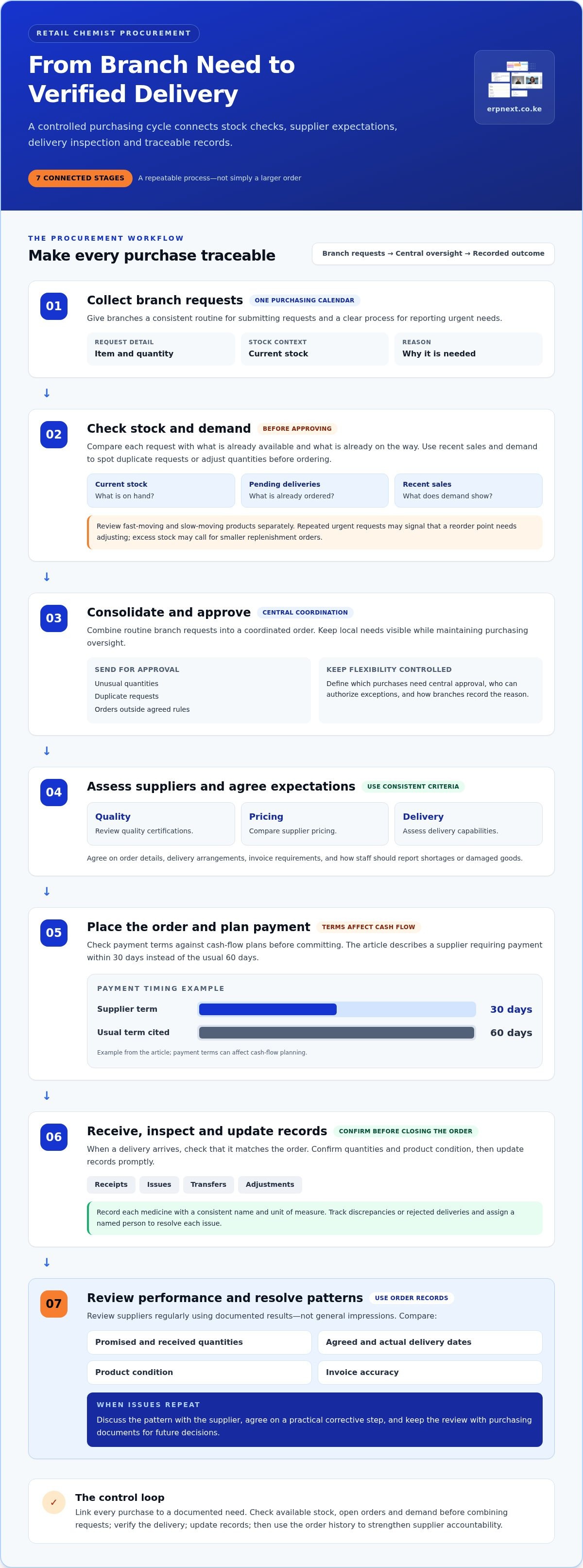
Efficiency starts with a repeatable purchasing routine, not a larger order. For centralized medicine procurement for retail chemists, consolidate branch requests into one schedule. Before approving a purchase, compare requested quantities with current stock, pending deliveries and recent sales. This helps the central team spot duplicate requests and adjust orders before sending them to suppliers. Give every branch a clear process for reporting urgent needs.
Build supplier relationships around clear expectations. Evaluate pharmaceutical suppliers using quality certifications, pricing, and delivery capabilities, then record how each supplier performs against those criteria. Agree on order details, delivery arrangements, invoice requirements, and how staff should report shortages or damaged goods. Payment terms deserve the same attention: one pharmaceutical procurement example describes a supplier requiring payment within 30 days instead of the usual 60 days. Compare such terms with cash-flow plans before committing.
Make inventory records useful at both central and branch level. Give each medicine a consistent name and unit of measure, and record receipts, issues, transfers and adjustments promptly. A branch request should specify the item, quantity, current stock and reason for ordering. Review fast-moving and slow-moving products separately. Repeated urgent requests for the same medicine may mean its reorder point needs adjusting; excess stock may call for smaller replenishment orders.
- Set one purchasing calendar so branches submit routine requests through the same process.
- Use an approval step for unusual quantities, duplicate requests, or orders outside agreed purchasing rules.
- Track supplier on-time delivery rate alongside quality, pricing, and delivery capability.
- Review stock discrepancies and rejected deliveries, then assign a named person to resolve each issue.
Review supplier performance regularly, using order records rather than general impressions. Compare promised and received quantities, delivery dates, product condition and invoice accuracy. Discuss recurring issues with the supplier and agree on a practical corrective step, such as confirming order details before dispatch. Keep review records with purchasing documents so future decisions draw on a consistent history.
Link each purchase to a documented need. Before combining branch requests, check available stock, open orders and demand. When the delivery arrives, confirm it matches the order and update records promptly. These steps make decisions easier to trace, strengthen supplier accountability and help retail chemists balance availability with controlled purchasing.
Check stock against pending deliveries and recent demand before confirming replenishment. Record whether each supplier delivered by the agreed date, then use the on-time delivery rate to review performance consistently. Keep the measure with the relevant order details so you can distinguish a late arrival from a change in the purchasing schedule.
Look for repeated delays and discuss them with the supplier before they disrupt branch plans. Clarify delivery expectations, confirm timing for future orders and consider whether ordering practices need adjusting. Revisit the measure during supplier reviews and apply the same method across branches.
2. Centralized and decentralized procurement strategies
Retail pharmacies commonly centralize medicines with predictable repeat demand and consistent specifications, such as standard-pack essential medicines and routine chronic-care lines. Branches may handle unusual requests locally when demand varies sharply. The right division depends on demand patterns, product requirements and supplier availability.
Kenyan pharmacy associations and pooled-purchasing platforms serve different purposes. An association can connect pharmacy professionals, but pooled purchasing requires a defined group with shared ordering, payment and allocation arrangements. Membership alone does not create a shared procurement system.
With centralized procurement, head office consolidates branch requests and places coordinated orders. This gives the business a single view of purchasing commitments and supports consistent product specifications across locations. It can also simplify supplier communication: a designated team coordinates the purchase and tracks fulfilment instead of separate branches negotiating the same order.
Central control has trade-offs. A central buyer may not spot a sudden local change in demand as quickly as branch staff. Set a process for branches to report demand changes, stock concerns and urgent needs. The central team can then adjust the next consolidated order or approve a local purchase.
Decentralized procurement gives each branch more control over ordering. Local staff can respond to their customers and immediate stock needs, but separate purchasing makes it harder to compare supplier terms, monitor total commitments and keep product choices consistent. Set clear purchasing limits and require branches to record orders in a shared system, keeping local decisions visible to management.
A hybrid model combines central coordination with controlled branch flexibility. Headquarters can set the approved product list and coordinate routine replenishment, while branches submit requests for exceptional demand. Define which purchases need central approval, who can authorize an exception and how the branch records the reason. This preserves oversight without forcing every local need into one ordering cycle.
Choose the model by mapping products to demand. Centralize items with predictable use and consistent specifications; allow local input where demand differs between branches. Then compare order histories, supplier performance, and stock records to see whether the arrangement is working. A shared procurement workflow management system can help keep branch requests and central approvals in one process.
3. E-procurement and procurement software
E-procurement replaces scattered messages and paper forms with a traceable digital workflow. For a Kenyan retail chemist, the process might start when a branch submits a medicine request through a shared system. The request then moves through review, approval, purchase order creation and receipt recording. Assign an owner to each stage to reduce reliance on disconnected spreadsheets and inbox searches.
Map the purchasing journey before choosing software. Record who raises requests, who approves them and who turns approvals into orders. For example, a branch pharmacist might submit a request while a central buyer checks it against purchasing rules. Configure roles around actual responsibilities so staff know what actions to take and handovers are clear.
Use a consistent digital catalogue for medicine names, pack descriptions and units of measure. If one branch records a product by pack and another by individual unit, stock totals may be misleading. Agree on a naming convention and clean existing records before importing them. A test order can reveal duplicate entries or mismatched units before routine purchasing begins.
- Capture the requesting branch, product description, quantity, and business reason on each request.
- Keep approval history attached to the purchase order, including changes made before submission.
- Record supplier responses and delivery status against the related order.
- Match received quantities to the order and note shortages or discrepancies for follow-up.
Useful reports turn records into decisions. A buyer can compare requested and ordered quantities, identify orders awaiting approval and review suppliers with outstanding deliveries. A dashboard showing repeated changes to one product request, for example, can prompt a review of the catalogue entry or branch ordering instructions. Reports are most useful when staff enter information consistently.
Plan for practical access across branches. Confirm the workflow works on the devices staff already use, and assign individual user accounts rather than shared logins. Train employees with a sample request, approval and receipt process. A short internal guide can explain what to do when a product description is missing or a delivery has a discrepancy.
Roll out the system in stages. Start with a limited purchasing workflow, gather staff feedback and fix confusing fields before expanding it. Track practical indicators such as requests needing correction, orders awaiting approval and unresolved delivery discrepancies. E-procurement adds value when each digital step reflects a real responsibility and produces usable records.
4. Order placement, delivery, and inspection
In Kenya, wholesale medicine prices and minimum order quantities depend on the medicine, pack size, supplier, order volume and delivery terms. Request a written quotation for the exact product and quantity, with the price unit and minimum order clearly stated.
Before ordering, compare the supplier’s quotation with the approved purchase request. Confirm the medicine name, strength, dosage form, pack size, quantity, agreed price, delivery location and expected date. A request for tablets, for example, should not be approved against a quotation for a different strength or pack. Keep the approved quotation with the purchase order so staff can compare the delivery with the agreed terms.
Use a consistent receiving sequence at every branch:
- Match the delivery note to the purchase order, checking product descriptions and quantities.
- Inspect outer packaging for damage, moisture, broken seals, or other visible concerns.
- Compare batch details and expiry information on packs with the accompanying documents.
- Record accepted quantities and separate discrepancies for review before updating stock.
Assign a named employee to check the delivery and record the result. Verify each product line rather than accepting the order as one total. Note shortages, substitutions, damaged packs or mismatched descriptions on the receiving record. This gives you a clear basis for resolving issues with the supplier.
Storage conditions matter during handover. Move accepted products promptly to their designated storage areas, following the stated handling instructions. If a delivery includes items requiring specific temperature conditions, review the relevant records and packaging before acceptance. Keep products with unresolved condition concerns separate from usable stock until the responsible staff member reviews them.
Close the order only after recording the received quantity and assigning any discrepancies for follow-up. Link the purchase order, delivery note, invoice, inspection result and supplier correspondence in one practical record. If the order specifies more than the delivery contains, for example, record the difference and track its resolution rather than changing the original order.
Review delivery performance using completed orders. Compare promised and actual delivery dates, quantities received and inspection outcomes. Repeated delays or discrepancies can inform future order timing and supplier decisions. These records also help central teams see whether an issue affects one branch or several, and coordinate follow-up without losing the order history.
There is no single typical price or minimum quantity: both vary with the product, supplier, order size and delivery terms. Confirm the unit price and minimum order in a written quotation before placing an order.
5. Regulatory compliance and quality assurance
Central purchasing can improve oversight, but relying on a single supplier or ordering route can concentrate risk. Stockouts may follow when central forecasts miss a branch’s needs or deliveries are delayed. Counterfeit medicines are also a quality risk when sourcing and product checks are weak. Use branch-level stock visibility, documented supplier checks and a clear escalation process to address both risks.
Carry out supplier due diligence before adding a source to the approved supplier list. Review quality documentation, product details, delivery procedures and how the supplier handles complaints or recalls. For organizations managing international manufacturing or overseas supply chains, working with on-the-ground procurement partners like Buying Office Asia provides direct vendor verification and quality oversight. Similarly, a central pharmacy team can apply structured review methods across local suppliers and keep a clear audit trail for each purchasing decision.
Match every order to the product and its supporting records. Check the medicine name, strength, dosage form, manufacturer, batch details and expiry information against the purchase documents and delivered pack. If details differ, pause acceptance and document the discrepancy. Keep questioned stock separate while the responsible staff member investigates, rather than placing it in saleable inventory.
Requirements depend on the product being procured. For sterile injectable medicines, ISO 9001 may be an example of a required certification. Hospitals procuring sterile injectables should verify supplier compliance with GMP regulations, for example through audits or certifications. These examples concern sterile injectables and hospital procurement; retail chemists should apply product-appropriate checks rather than assuming every example applies to every medicine.
Use a written quality procedure that assigns responsibility for each control. A receiving employee can inspect packaging and documents, while a designated manager reviews exceptions and decides what to do. Store inspection records with the relevant order and delivery documents. If a supplier reports a recall or quality concern, these linked records help identify affected batches and branches quickly.
- Maintain approved supplier records with dated review notes.
- Link purchase orders, delivery records, batch details, and inspection outcomes.
- Track stock availability by branch to spot emerging shortages.
- Record suspected quality issues and the steps taken to contain them.
For raw materials, pharmaceutical suppliers may work with a pharmaceutical company to ensure ingredients meet FDA regulations. This example concerns raw-material supply, not a blanket rule for retail medicine purchasing in Kenya. Keep the applicable product requirements clear in each supplier review.
Central oversight works best when staff can trace decisions from supplier approval through receipt and stock records. Strengthen that process with a structured procurement workflow that helps organize purchasing information and approvals.
Centralized drug procurement in hospitals affects institutional economic performance, medical quality and patient safety. Quality controls should therefore inform purchasing decisions as well as receiving checks. Assess whether proposed savings are consistent with product requirements, reliable supply and the records needed to verify what was purchased and delivered.
A consistent review process helps decision-makers weigh cost and continuity without weakening safeguards. When concerns arise, document the issue, the decision and any follow-up so purchasing and clinical teams can act on the same information. Use these records to improve supplier reviews and ordering practices, while keeping responsibility for decisions affecting product quality and patient care clear.
TSEA - ERPNext: ERPNext
TSEA - ERPNext offers ERPNext and Pharmacy Chain Management for retail chemists looking to coordinate operations across branches. These solutions are relevant when procurement decisions, branch processes and business management need a more connected approach. Pharmacy teams can explore how an ERP platform fits their operating model and wider management needs.
Consider this approach when reviewing procurement workflows alongside other business processes, rather than treating purchasing as an isolated task. Start by understanding how your branches work and what you need to manage centrally.
To discuss ERPNext and Pharmacy Chain Management for your business, visit erpnext.co.ke.
Turn Your Procurement Plan Into the Next Step
A well-designed approach to centralized medicine procurement for retail chemists should fit how your branches make decisions, handle exceptions and plan for growth. Before changing processes, identify one workflow that needs clearer ownership and define what a better result would look like. This gives your team a practical starting point grounded in your operations, not a generic template.
Then consider how procurement fits with the rest of your pharmacy management. TSEA - ERPNext offers ERPNext and Pharmacy Chain Management for businesses exploring a more connected management approach. The goal is to move from current processes toward the operating model you want, with clear priorities for your team.
Contact TSEA - ERPNext to discuss procurement and explore how its offerings may fit your business. A focused conversation can help you shape your next move with confidence.
Frequently Asked Questions
What is Pharmaceuticals Procurement?
Pharmaceutical procurement is the process of sourcing and purchasing medicines and related products for an organization. It includes identifying requirements, selecting suppliers, placing orders, receiving products and keeping purchasing records. For example, a retail chemist may plan a medicine replenishment, compare supplier offers and document what arrives. Good procurement connects purchasing decisions with product quality, availability and operational needs.
How do centralized procurement costs compare with buying from multiple wholesalers?
Centralized purchasing isn’t automatically cheaper than buying from multiple wholesalers; compare the full cost and operational impact of each approach. For centralized medicine procurement for retail chemists, assess quoted product prices alongside delivery charges, order handling, payment terms, and the risk of excess or insufficient stock. Multiple wholesalers may offer flexibility, while consolidated orders can simplify coordination. Compare equivalent products, pack sizes, and delivery terms before deciding which model best fits your branches.
What steps are needed to set up a group purchasing organization for Kenyan chemists?
Form a defined group of chemists and agree on shared ordering, payment and allocation arrangements. Association membership alone does not create a pooled purchasing system.


