
A medication’s chain of custody depends on more than knowing what is on the shelf. For Kenyan pharmacies, controlled substance register tracking software can record who handled a controlled medicine, what action took place and when, creating a traceable history from receipt through transfer, dispensing or disposal.
That record matters: a stock discrepancy can interrupt dispensing and make an audit harder to manage. Digital tracking helps organise register entries, restrict access to sensitive workflows, document approvals and maintain a clearer history of inventory changes.
This guide explains controlled substance tracking and how software can support registers, transaction records and chain of custody. It also covers what to consider when assessing a solution for your pharmacy’s inventory processes in Kenya, including staff access, reconciliation and record review.
Key Takeaways
- Map each controlled medicine’s journey from receipt to transfer, dispensing or disposal to make gaps in custody easier to spot.
- Set clear user permissions, approvals and reconciliation steps so sensitive inventory actions are accountable.
- Keep transaction histories structured and reviewable; Kenyan dispensing facilities must report controlled-substance activity promptly in compliance with the Pharmacy and Poisons Board standards.
- Assess pharmacy software like TSEA - ERPNext by how well it supports register records, stock oversight and traceable activity across locations.
- Compare vendor solutions against your pharmacy’s workflows and the controls needed to manage inventory records consistently.
Software and medication-management solutions
Medication-management software brings stock records, medication lists and staff activity into one working view. For a controlled medicine, the record can capture its receipt, storage movement, dispensing and disposal. Each action can be timestamped and authenticated, then stored in a tamper-resistant database. That sequence gives pharmacy teams a practical way to trace what happened, who recorded it and when.
Start with the medication list. Record the medicine’s name, strength, dosage form and relevant dispensing instructions, keeping each field clear for staff reviewing the entry. A dosage protocol should guide authorised staff through required checks; software records the protocol and actions but does not replace clinical judgement. For example, a pharmacist can compare prescription details with the selected item before completing a dispensing entry.
Dose logging makes the administered or dispensed amount part of the transaction history. Capture the amount, date and time, responsible user, and any adjustment or correction. If an entry needs correction, preserve the original activity and add a traceable explanation rather than overwriting it. This helps distinguish a documented correction from a stock discrepancy and gives reviewers a clearer record to examine.
Access controls help limit who can change sensitive records. Restrict inventory adjustments and controlled-medicine workflows to authorised users, and separate reconciliation duties from routine stock handling. For example, one user can record a movement while another reviews a count difference. Tracking user activity across inventory records helps managers investigate unusual changes and identify where errors entered the process.
Specialty medications may need tighter controls, more detailed tracking and stricter storage requirements. A pharmacy can identify these medicines in its inventory workflow, document their movements and define who can handle related records. Controls should reflect the medicine and the pharmacy’s procedures. This focused approach improves visibility without treating every item as if it followed the same storage or handling pathway.
- Build a usable record: Maintain clear medication details and dispensing instructions for each controlled item.
- Log actions: Capture who performed each stock or dose-related activity, what changed and when.
- Separate responsibilities: Assign inventory adjustments and reconciliation reviews to appropriate users.
- Apply focused controls: Flag specialty medications for the tighter tracking and storage processes they require.
Pharmacies can design a custom inventory database to address DEA and 340B compliance needs. Its structure can be tailored to those requirements, alongside the pharmacy’s choices about access to inventory adjustments and controlled-substance workflows. Keeping reconciliation responsibilities separate and tracking user activity across inventory records can reinforce visibility into how the inventory is managed, while timestamped, authenticated actions in a tamper-resistant database preserve a traceable activity record.
Audit-ready inventory records and transaction histories
A review-ready record connects each stock movement to its source, responsible user and supporting evidence. Compare systems based on how clearly they preserve that history and produce reports staff can use to examine pharmacy activity.
Audit Trails and Reporting
Check whether each record shows the action, timestamp, user, medicine and reason for a change. A useful audit trail preserves original entries and documents corrections, approvals and discrepancy reviews. Reports should be filterable by date range, unit, location or user, helping staff investigate specific stock activity without sorting through unrelated transactions.
GPS-stamped records can add location context to a documented movement. For example, a location entry alongside a transfer record may help reviewers compare recorded activity with the pharmacy’s movement process. Treat location as supporting information, not a replacement for the responsible user, transaction details or an approval record.
Keep the workflow practical: record the discrepancy, assign a reviewer, document the resolution and retain supporting notes. Automated reports can help teams flag incomplete entries or unusual adjustments for review. Use a consistent review process for controlled medicines, including opioid inventory, so staff can investigate exceptions and clearly record the outcome.
Record-Keeping and Retention Requirements
In Kenya, pharmacies should organise controlled-medicine register processes around applicable Kenyan requirements and Pharmacy and Poisons Board rules. The relevant obligation depends on the record and activity involved, so map each record type to its applicable requirement before configuring the system. Do not assume one template covers every medicine, transaction or healthcare organisation.
Useful records include medicine identification, quantities received and dispensed, transaction dates, responsible users, adjustments, transfers, approvals and discrepancy resolutions. Link supporting documents to relevant entries, such as receiving evidence or an explanation for a correction. This lets reviewers follow the transaction history instead of inferring what happened from disconnected files.
Retention periods depend on the applicable rule and record category. Create a schedule for each record type, preserve records needed for active reviews, and ensure archived entries remain readable and retrievable. Review the schedule when record categories or operational processes change.
For a Kenyan pharmacy, distinguish local obligations from requirements that apply in other jurisdictions. Configure access, reporting and retention around applicable Kenyan rules, then test retrieval using a sample transaction. This helps confirm that staff can find the record and its supporting evidence during an internal review.
Choose a system that keeps reports, supporting records and user activity connected. For teams mapping pharmacy workflows, pharmacy chain management can be a relevant operational starting point.
Controlled drug register software for pharmacies
A pharmacy tracking system should connect stock movements, digital records and physical storage procedures. In Kenya, assess how each feature fits your pharmacy’s actual inventory workflow.
Controlled Drug Inventory Management
Inventory management records quantities received, dispensed, transferred, adjusted and disposed of. For each medicine, match its item record to the quantity on hand, storage location and transaction history. Useful stock views can organise inventory across vaults, boxes, lockers and vehicles, while threshold settings can flag low stock or approaching expiry.
Review how the system handles discrepancies: staff should be able to record the variance, document its cause and route it for review. Software can support these controls, but it does not replace suitable physical storage hardware or pharmacy procedures. Link the digital location entry to the actual storage area, such as a designated vault, to make counts easier to reconcile.
Digital Controlled-Drug Logbooks
An electronic logbook turns each receipt or dispensing event into a dated record tied to a specific user and medicine. Check that entries capture quantity, transaction type, location and any required note, with corrections preserved rather than replacing earlier details. A transfer between pharmacy locations, for example, should show both the outgoing and receiving movements.
Digital entries make searching and reporting more direct than reviewing separate paper pages. Before adoption, define which staff record each event and who reviews corrections. Use familiar examples in training, such as receiving a delivery and recording a dispensing transaction, so pharmacy staff follow the same steps consistently.
Security, Access Control, and Data Protection
Assess who can view records, create entries, approve adjustments and export reports. A user who records a count should not automatically control every review step; role-based permissions can separate those tasks and make activity easier to trace. Check how the system authenticates users, protects stored records and handles account changes when staff responsibilities change.
Data risks include shared credentials, excessive access, unreviewed exports and poor handling of corrections. Set individual accounts, limit permissions to assigned duties and review access when roles change. For example, a dispensing user may enter a transaction while a supervisor reviews a discrepancy, keeping responsibility for each action clear.
Software Setup and Implementation
Implement the system in a defined sequence: map medicine records and storage locations, assign staff roles, configure transaction fields, then test receiving, dispensing, transfer and adjustment workflows. Compare test entries with a physical count before relying on the new tracking system. This can catch mismatched item names or location labels early.
Integration with pharmacy systems or electronic health records in Kenya depends on compatible data exchange, field mapping, permissions and the workflow being connected. Define whether the goal is to share medication details, dispensing records or inventory updates, then test that exchange before rollout. Train staff using real pharmacy tasks and document how the team handles system interruptions.
Controlled substance chain of custody
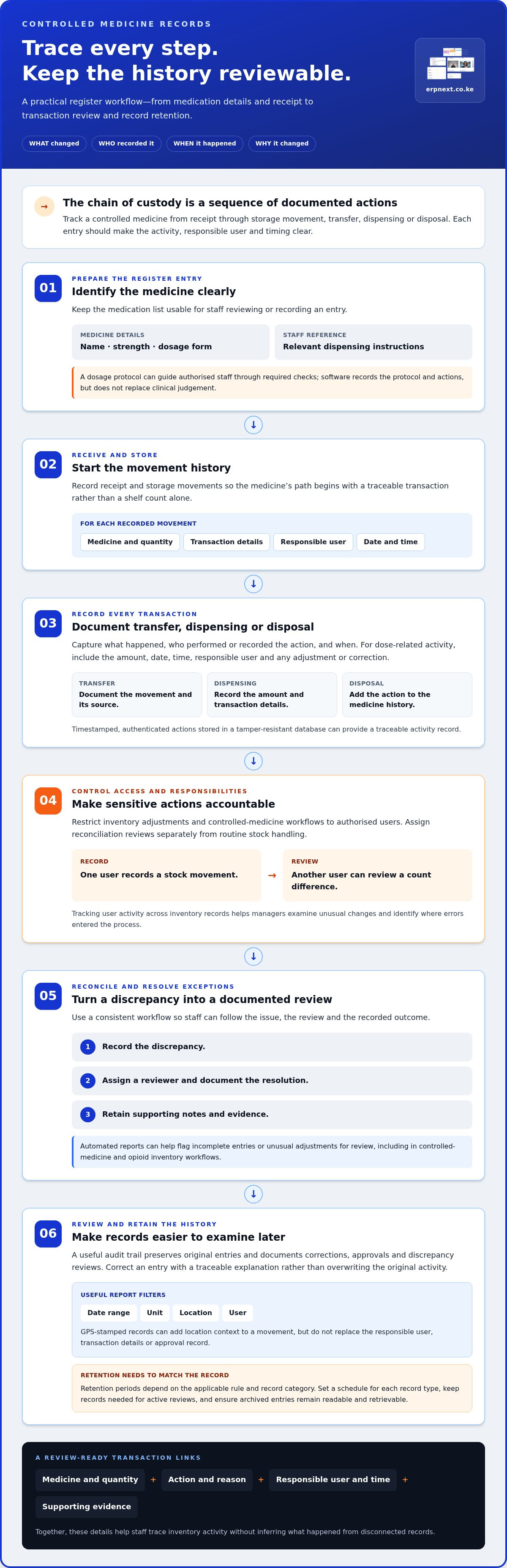
Chain of custody shows who handled a controlled medicine, what happened and when. A useful tracking process connects each handoff, from receipt through storage, transfer, administration and final disposal.
Build the record around each custody change. At receipt, log the medicine, quantity, date, receiving user and storage location. For a transfer, record the sending and receiving users, quantity moved and destination. When a dose is administered, link the transaction to the responsible user and document the amount and time. Expiration and disposal also need traceable entries.
Two authorised users can verify critical controlled-substance actions. For example, one user records a vault restock while another checks the quantity and approves the entry. This dual-check creates distinct accountability instead of relying on one person to enter and validate the same movement. Set approval requirements according to the action, such as a transfer or inventory adjustment.
A chain-of-custody system should keep an unbroken history, not just a current stock balance. If a vial moves from a main vault to a dispensing area, the record should show its origin, destination, quantity and handling users. If a count differs, document the observed quantity, review related movements and record the resolution without removing the original transaction.
- Identify the item: Use a consistent medicine description and link it to the relevant inventory record.
- Capture the handoff: Record the users, action, quantity, time and location for each movement.
- Verify critical actions: Require two authorized users to confirm high-risk transactions.
- Close the record: Document administration, expiration or disposal as the final custody event.
For hospital and pharmacy workflows, define custody points between departments before configuring the tracking system. A transfer from a central store to a ward, for instance, should have a named sender, receiving provider and matching quantities. Separate responsibilities for handling, recording and reconciliation so each stage has an accountable owner.
For Kenyan pharmacies, distinguish internal custody controls from applicable local regulatory requirements. Set procedures for clear handoffs, named users and documented verification, then align them with the pharmacy’s relevant obligations. This keeps local compliance considerations separate from operational practices drawn from other jurisdictions.
When assessing software, test a complete example: receive a controlled medicine, move it between storage locations, record administration and close the item through disposal. Confirm that each action remains traceable in the transaction history. A workflow that captures the full journey gives pharmacy, hospital and healthcare teams a clearer basis for reviewing inventory activity and investigating discrepancies.
Which software vendors offer controlled substance register tracking in Kenya?
Kenyan pharmacies can assess pharmacy-management platforms, broader ERP systems and specialist inventory tools for controlled-medicine workflows. The key question is whether the software supports the register process your pharmacy needs, rather than simply showing stock balances. Compare transaction history, access controls, reporting and location-level inventory features in a realistic pharmacy scenario.
Pharmacy-management platforms are designed around pharmacy operations. Test whether a platform connects medicine records with receiving, dispensing, adjustments and stock reviews. For example, follow one item from delivery receipt to dispensing, then check whether the resulting record shows the users and actions involved.
ERP systems offer a wider operational framework, which may suit organisations managing pharmacy activity alongside other business processes. Assess whether pharmacy inventory can be tracked at the required level of detail and whether reports can be filtered by location, user or date range. A broad platform is useful only if the controlled-medicine workflow remains clear and accountable.
Specialist inventory tools may focus on stock control, storage locations or transaction documentation. Test a transfer between your pharmacy’s storage areas, such as a vault and dispensing location. The record should connect the item, movement and responsible users. Also assess whether adjustment reviews and discrepancy notes remain available for later examination.
Compare vendors using the same practical scenarios rather than relying on feature-list claims. Ask the evaluation team to demonstrate:
- Register workflow: Record receipt, dispensing, transfer, adjustment and disposal.
- Access control: Show how user permissions separate recording and review duties.
- Audit reporting: Retrieve transactions by date range, location or user.
- Inventory visibility: Review stock by pharmacy location and storage area.
- Correction handling: Demonstrate how an amended entry preserves its history.
For a Kenyan organisation, implementation fit also depends on staff roles, existing medicine records and how each branch handles inventory. Map those workflows before comparing proposals. Then test the proposed setup with representative entries and confirm pharmacy staff can retrieve the records they need for review.
Keep the selection focused on the work, not the vendor’s label. A pharmacy that needs multi-location visibility should test branch-level records; a facility prioritizing handoffs should test transfer documentation. Explore pharmacy operations software options as part of your comparison, and assess each solution against the same controlled-medicine scenarios.
TSEA - ERPNext: ERPNext
TSEA - ERPNext offers ERPNext and Pharmacy Chain Management for businesses assessing how to organise pharmacy operations within a broader management platform. It is a natural next step if your team wants to evaluate pharmacy workflows alongside wider business processes, rather than treating register tracking as an isolated task.
Bring your controlled-medicine process into the discussion: outline how your pharmacy records receipt, dispensing, transfers, adjustments and reviews. These requirements help frame how a management platform could fit your operational needs, while keeping register procedures and applicable Kenyan requirements central to planning.
If you’re ready to explore ERPNext for your pharmacy operations, contact TSEA - ERPNext to discuss your requirements.
Make Your Next Pharmacy Systems Decision Count
Your next step is to turn operational priorities into a clear implementation brief. Identify the register workflows that matter most, the teams responsible for each action and the records managers need to review. Use those priorities to assess how a controlled substance register tracking software approach fits your pharmacy’s wider management needs.
TSEA - ERPNext offers ERPNext, Pharmacy Chain Management and Hospitality. For pharmacy teams, the relevant discussion is how Pharmacy Chain Management can fit within a broader business platform and support operational planning. Define your requirements first, including workflow boundaries and reporting needs, so the conversation stays practical and focused on your organisation.
Ready to explore the next step? Contact TSEA - ERPNext to discuss your pharmacy management requirements. A clear brief can help you move forward with confidence and build a stronger foundation for your software decision.
Frequently Asked Questions
What Is Controlled Substance Tracking?
Controlled substance tracking follows a medicine’s accountable path through pharmacy operations, including receipt, storage, dispensing and final disposition. For example, if a package arrives with a quantity that differs from its delivery record, tracking helps staff compare the received amount with the order and document the variance. This gives pharmacy teams a consistent way to examine an item’s history rather than relying on separate notes or staff recollection.
Where is the data stored?
Tracking data is stored in the system’s configured database, which may be hosted in a cloud environment or on infrastructure managed by the organisation. The setup determines where records reside and how authorised staff access them. Before implementation, identify who controls user accounts, backups, exports and retention settings. For example, a pharmacy group should know whether branch staff work from one shared record system or separate databases.
What is controlled substance register tracking software and how does it work?
Controlled substance register tracking software is a digital tool for recording controlled-medicine inventory activity and retrieving its history. Staff enter events such as receipt, dispensing or adjustment, while the system links each entry to relevant medicine and user details. A supervisor can then review an item’s record, investigate a variance and document follow-up. The software organises records; pharmacy procedures determine how staff perform and approve each task.
What are the prices and subscription costs of controlled substance tracking software in Kenya?
In Kenya, software costs depend on the project and are provided after a quote request. Key cost factors include the number of pharmacy locations and users, implementation scope, data migration, integrations, training and ongoing support arrangements. A pharmacy seeking a basic inventory workflow may have different requirements from a chain coordinating records across branches. Define the workflows and system connections you need before comparing a proposed subscription or implementation quote.
How does the software handle dispensing, stock reconciliation, discrepancies, and expired medicines?
The system records dispensing against inventory, then helps staff compare recorded balances with physical counts. If quantities differ, enter the variance, investigate relevant transactions and document the review outcome. For expired medicine, record its status, remove it from available dispensing stock and document its disposition under pharmacy procedures. For example, a scheduled stock review can flag an expired item for segregation before staff select stock for dispensing.


