
Panorama Consulting’s 2025 research puts the ERP project failure rate at 68%, but “failure” often means missing goals, timelines, or expected benefits, not abandoning the system altogether. ERP implementation mistakes can begin well before go-live, when teams expect software alone to fix broken processes or assume employees will simply adapt.
If you’re concerned an implementation could disrupt daily operations, focus on the risks that matter most. Poor data preparation, unclear priorities, and limited employee involvement can turn early decisions into costly downstream problems. These risks are easier to manage when decisions, data, and adoption stay connected from the start.
This article separates common ERP myths from the mistakes behind them, explains how those choices can derail progress, and shares practical ways to protect business continuity and support confident system use. It also explains how to assess ERPNext as a business management platform. TSEA provides ERPNext implementation and business management solution services for organisations considering their next step.
Key Takeaways
- Recognize how common beliefs can disguise decisions and omissions that undermine agreed business goals.
- Set clear outcomes before configuration begins to reduce scope drift and mismatched expectations.
- Catch ERP implementation mistakes in data transfer, customization, and testing before they compound.
- Support adoption after go-live by monitoring system use, gathering feedback, and prioritizing issues.
- Connect goals, ownership, data, testing, and adoption to identify which project decision needs attention first.
ERP implementation mistakes begin with myths about what makes a project fail
An ERP implementation mistake is a decision or omission that undermines the business goals a project was meant to achieve. Examples include configuring a workflow before agreeing how the work should happen, leaving key users out of decisions, or measuring progress only by whether the system launches. The common thread is a gap between project choices and the outcomes the business needs.
ERP success is measured by whether the system enables agreed business outcomes, not by the go-live date alone. A challenging implementation isn’t automatically a failed one. Teams may face difficult data decisions, adjust workflows, or refine training while still moving toward their objectives. A project falls short when unresolved issues prevent intended teams from carrying out essential work or leave agreed benefits out of reach.
Software selection is only one part of the picture. Enterprise resource planning (ERP) brings business functions and information together, but the platform can’t decide which process an organisation should follow, who owns an approval, or what clean, reliable data looks like. Those choices need business agreement. Treating them as technical details can make an otherwise capable system confusing to use.
Myth: ERP software alone determines implementation success
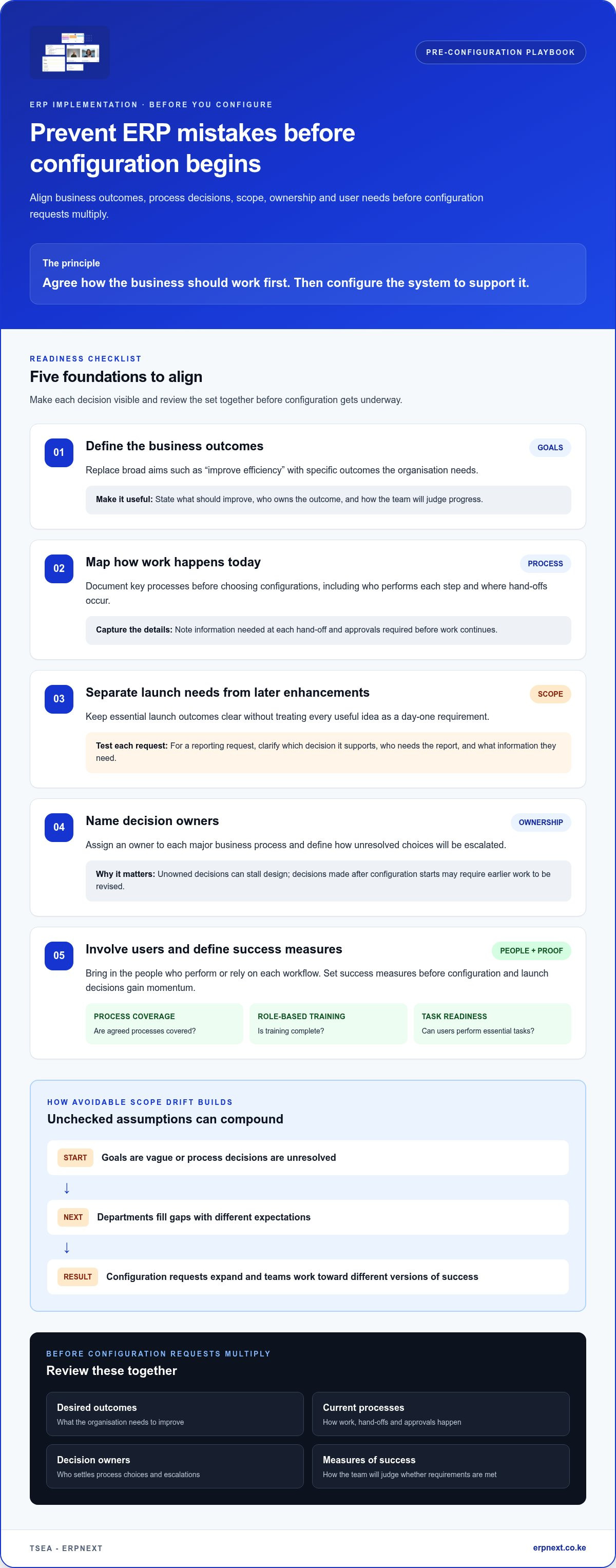
Processes, ownership, data quality, and user adoption all shape how well an ERP supports day-to-day work. For example, if a team hasn’t agreed who approves a purchase, configuring different departments’ assumptions into a workflow can leave staff unsure which route to follow. The resulting delays may look like a software problem, but the underlying issue is an unresolved business decision. Agree on the process and name its owner before configuration begins.
Myth: A go-live date proves the project succeeded
A technical launch confirms that the system is available; it doesn’t prove that intended teams can use it reliably in daily operations. Set success measures in advance, such as whether agreed processes are covered, role-based training is complete, and users are ready to perform essential tasks. Compare actual use with those targets after launch. Refining reports, instructions, or workflows can be part of improving the system’s fit, not automatic evidence of failure.
Make the project’s definition of success visible before configuration and launch decisions gather momentum. Record the business outcomes, process owners, and measures the team will use to judge progress. This shared reference helps distinguish a temporary implementation challenge from a failure to meet the goals, and gives teams a practical basis for deciding what to address next.
Before implementation, vague goals and unchecked assumptions create avoidable ERP mistakes
“Improve efficiency” sounds like a clear ERP objective until teams need to decide what to change, which work takes priority, and how to measure progress. Without specific business outcomes, departments fill gaps with different expectations. Those assumptions shape configuration requests, new requests expand the scope, and teams can end up working toward different versions of success.
A useful ERP objective is measurable, owned by a responsible business lead, and grounded in the outcomes the organisation needs. Before selecting configurations, document how key processes work now and what should improve. Note who performs each step, where hand-offs happen, and what a better result would look like. ISG’s guidance on ERP implementation success also highlights the value of clear planning and stakeholder involvement.
Myth: One ERP project scope fits every business
There’s no universal scope that suits every industry, operating model, or business size. A pharmacy chain may prioritise different workflows from a hospitality business, while organisations in the same sector can have different launch needs. Separate what must work at launch from enhancements that can be considered later. This keeps essential outcomes visible without treating every useful idea as a day-one requirement.
Consider a request to “make reporting easier.” Without a defined need, it could grow into new dashboards, extra data fields, and changes to several workflows. Clarify which decision the report should support, who needs it, and what information they need to make that decision. This turns a broad request into a focused business requirement and helps teams assess its priority without letting assumptions drive scope expansion.
Myth: Leadership can delegate every important decision
Leaders can delegate project work, but they still need clear decision ownership. If nobody has authority to settle how a process should operate, design can stall while teams wait for agreement. If a decision comes after configuration has begun, earlier work may need revision. Name an owner for each major business process and define how unresolved choices will be escalated.
Involve the people who perform or rely on each workflow early. They can identify practical details a high-level process description may miss, such as information needed at a hand-off or an approval required before work continues. Their input helps distinguish essential operating needs from preferences and gives project owners a stronger basis for timely decisions.
Keep preparation focused: record current processes, desired outcomes, decision owners, and the measures that will show whether requirements are met. Review these together before configuration requests multiply. For organisations exploring ERPNext as a business management platform, ERPNext for business management is a natural next step once priorities are clearer.
During ERP implementation, data, customization, and testing mistakes compound
As project decisions move into configuration and preparation, small assumptions can spread across connected workflows. Data that looks usable may contain duplicate or outdated records; a change intended to help one team may affect another; and a brief demonstration may leave important gaps undiscovered. These ERP implementation mistakes compound because each decision shapes what users see and how work moves through the system.
Test whether information and workflows support real business activity from beginning to end. Don’t treat data transfer, system changes, and testing as separate technical tasks. Each needs business input from people who understand which records matter, why a process works as it does, and what users need to complete their responsibilities.
Myth: Data migration is just a technical transfer
Reality: Moving records doesn’t make them accurate or useful. Identify relevant information, agree who owns it, and check that it reflects current business needs. If ownership is unclear, departments may submit incomplete or inconsistent details, carrying old problems into the new system. For instance, an inaccurate product record could mislead staff checking stock or preparing an order, while an outdated customer record can complicate routine follow-up.
Focus on business meaning, not just whether information appears in the new system. Ask who relies on each important record and what errors would disrupt their work. That context helps teams decide which information needs attention and who is responsible for its quality.
Myth: Customization and a quick test will solve every process gap
Reality: Configuration can align an ERP with agreed business needs, but changes intended to recreate every old step may preserve inefficiencies and make the system harder to manage. Extensive customization can also create more interactions to examine, increasing the chance that a change works in isolation but disrupts a connected task. Before changing a process, distinguish a genuine operating requirement from a familiar habit.
Testing should reflect complete, realistic work, not just a polished demonstration of individual screens. Follow a scenario through the relevant approvals, records, and hand-offs. Does the right information reach the next person? Can the intended user complete their part? Does the outcome support the agreed process? These questions expose gaps that a quick feature check may miss.
Track test issues with enough context to understand their effect on everyday work. A minor inconvenience and a failure that blocks an essential task shouldn’t carry the same weight in a launch-readiness discussion. Give unresolved issues an owner and make a clear decision about their impact before proceeding. The goal isn’t to demand a flawless system on day one; it’s to make launch decisions with a realistic view of data quality, workflow fit, and user impact.
After ERP go-live, treating adoption and measurement as optional repeats old mistakes
Go-live changes the project’s focus; it doesn’t end the work of making the system useful. Staff now apply new workflows to live tasks, and the project team needs to see where actual use differs from the intended process. Without follow-up, confusion can become a habit, feedback can go unheard, and teams may create workarounds that weaken the value the implementation was meant to deliver.
Go-live is a transition point, not a success metric. Success depends on whether intended users can carry out agreed work and whether the system supports the project’s business outcomes. Initial training introduces the system, but ongoing guidance, questions, and process reinforcement help teams build confidence as they encounter real situations. Treating post-launch adoption as part of implementation connects improvement to everyday operations.
Myth: Staff will adopt the system automatically
New workflows can feel uncertain when responsibilities aren’t clear or staff don’t know where to get help. A user who can’t tell which step to take may delay work or return to a familiar workaround. Provide role-relevant guidance, reinforce what each team is expected to do, and make it easy to raise practical questions. Training is a starting point; confidence grows as people apply the system to their responsibilities.
Listen for repeated questions. They may signal that instructions need clarification, a process needs reinforcement, or staff need more practice. Team preparation and training should continue beyond launch, rather than being treated as a one-time event.
Myth: The project team can stop measuring once the system launches
Without follow-up measures, teams can’t tell whether a quiet system is working smoothly or whether users are struggling. Track the business and usage indicators agreed for the project, then compare them with user feedback. A missed step may point to a training gap, an unclear process, or a configuration issue. Understanding the cause helps the team choose a useful improvement instead of assuming every concern needs the same fix.
Keep the review loop simple and consistent:
- Monitor use: Compare activity and process coverage with the project’s agreed expectations.
- Gather feedback: Ask users where tasks feel unclear, slow, or difficult to complete.
- Prioritize issues: Address problems by their impact on essential work, not by volume alone.
- Review progress: Check whether changes resolve the issue and support the intended outcome.
This approach helps teams distinguish an urgent operational barrier from a preference that can wait. It also leaves room for post-launch refinement without labelling every adjustment a failure. ERP implementation mistakes can persist after launch if nobody owns the feedback loop, but a clear review rhythm keeps decisions visible and improvement focused.
TSEA provides ERPNext as an all-in-one business management platform. Explore ERPNext with TSEA to consider how adoption and measurement fit your business goals.
Turn ERP implementation mistakes into a connected plan for better decisions
The value of reviewing ERP implementation mistakes isn’t in producing a longer list of warnings. It’s in seeing how one decision affects the next. If a business goal is unclear, process choices may drift; if data ownership is uncertain, testing may not reflect real operations; if teams aren’t prepared, a technically sound workflow may still be difficult to use. Connect these decisions, and it becomes easier to spot where attention will make the biggest difference.
A practical way to review ERP project decisions
Review the project as a set of connected decisions, not isolated tasks. For each major choice, ask: What business need does it serve? Who owns the decision? What outcome should it support? Then check whether the process, data, testing, and user experience align with that outcome. This isn’t a full setup plan; it’s a way to expose gaps before they multiply.
Start with the issue that blocks the most downstream decisions. If users can’t agree on the intended process, settle that before judging configuration or test results. If the process is clear but its records are unreliable, data quality may be the constraint. Keep unresolved questions visible, assign someone to follow up, and record which decision will allow the next step to move forward. This creates accountability without treating every open issue as equally urgent.
A short review can focus on five connected areas:
- Goals: Are desired business outcomes clear enough to assess?
- Owners: Is there a named person responsible for each key decision?
- Data: Are important records understood and trusted by the teams who use them?
- Testing: Do scenarios reflect actual work across connected processes?
- Adoption: Can intended users carry out their roles and raise questions?
Use the answers to identify the first decision to resolve rather than launching a broad corrective effort. A clear process owner can often clarify what data matters, what a useful test should cover, and what guidance staff need. One well-placed decision can bring several project threads back into alignment.
Where ERPNext fits after the lessons
ERPNext is TSEA’s all-in-one business management platform. For organisations considering business management software for areas such as pharmacy chain management or hospitality, assess how the platform relates to agreed goals, processes, data, and user needs. Software can support business operations, but project decisions still shape how well it fits the intended outcomes.
With your priorities clearer, explore ERPNext with TSEA as a next step in evaluating a business management platform for your organisation.
Make your next ERP decision count
The next step isn’t to solve every risk at once. Choose the decision with the greatest influence on the work ahead, then bring the people who own and use that process into a focused review. Ask what outcome it needs to support, what evidence would show progress, and what must be decided before the team moves forward. That turns lessons into a practical action, not another list of project concerns.
Use the review to expose assumptions that have gone unchallenged. A decision that seems straightforward to one department may affect another team’s responsibilities or daily workflow. Make those connections visible, agree who will resolve open questions, and revisit the decision if its business purpose changes. This gives teams a clear basis for moving ahead without expecting every detail to be settled at once.
ERP implementation mistakes are less likely to take hold when teams connect decisions to business needs and assign responsibility for follow-through. Ready to explore ERPNext as a business management platform? Explore ERPNext with TSEA and take your next step with clarity.
Frequently Asked Questions
What are the most common ERP implementation mistakes?
Common ERP implementation mistakes include unclear goals, weak decision ownership, poor data preparation, inadequate testing, unmanaged change, and little measurement after launch. These risks can reinforce one another: unclear process ownership, for example, may leave supplier records inconsistent, undermining a purchasing test. There’s no universal ranking. The risk to address first depends on your organisation’s priorities, operating processes, and project conditions.
Can an ERP implementation fail even if the software works?
Yes. A system can be technically available but still fail to support the way the business needs to operate. For example, staff may be able to enter a sales order, but unclear approval responsibilities could prevent it from progressing smoothly. Assess whether the implementation supports agreed business outcomes, not only whether users can log in or features function. Technical operation is necessary, but it doesn’t prove the business goals have been met.
How can a business spot ERP implementation problems early?
Watch for decisions that repeatedly wait for approval, unresolved process questions, inconsistent records, recurring test failures, requests that keep expanding, or staff who can’t describe how their tasks will change. One signal alone doesn’t prove a project is failing. Record the issue, identify who can resolve it, and assess its effect on business operations. Escalating a blocked decision early can help prevent avoidable rework from spreading.
What happens if employees resist a new ERP system?
Resistance can slow adoption, but it may also point to an unanswered question or a process concern. A team unsure about new responsibilities may avoid a workflow or keep using familiar workarounds. Listen to affected employees, explain the business reason for the change, and provide guidance that matches their roles. Ask what specifically feels difficult before deciding on a response. Training can help, but it may not address every underlying issue.
How much does an ERP implementation failure cost?
There’s no single dependable cost figure for every business. The impact can include rework, time diverted from core tasks, operational disruption, and delayed or missed business outcomes, but the scale depends on the organisation and project. To estimate your exposure, compare documented project commitments and expected outcomes with actual effects on operations. Avoid applying a headline figure from another organisation as though it predicts your own loss.
Is ERP implementation complete when the system goes live?
No. Go-live starts live operation, but teams may still need to resolve issues and check whether expected outcomes are being achieved. A process may work during testing but prove confusing during a busy operating period, for example. Assign responsibility for reviewing post-launch concerns, set points to assess progress, and make decisions based on observed results. Refinement is part of responding to real use, not automatic proof that the project failed.
How can a business reduce the risk of ERP implementation mistakes?
Connect project decisions to business goals, give important choices clear owners, and consider process, information, testing, and user needs together. After launch, use feedback and agreed measures to guide improvements. These practices reduce avoidable risks, but can’t guarantee a particular result. For task-by-task planning, use a separate ERP implementation checklist alongside this broader decision-making guidance.


