
What if the biggest ERPNext implementation risk in Kenya isn’t the software, but configuring it before your business is ready? If sales, finance, inventory, and operations are spread across disconnected tools, it’s natural to want one platform quickly. But unclear scope, migration decisions, and team responsibilities can turn that move into disruption instead of progress.
A successful ERPNext implementation in Kenya starts with business fit. Before configuration begins, identify which processes should connect, what data must move, who will own key decisions, and how local invoicing and payment workflows fit your operations. Those choices help shape a rollout your team can realistically adopt.
This 2026 buyer’s guide shows you how to assess ERPNext against your operating model, define implementation priorities, and prepare for data migration and change across the business. You’ll also learn which decisions to settle before configuration and how to build a practical rollout plan. TSEA - ERPNext provides ERPNext implementation and an all-in-one business management platform for businesses across a range of industries, including pharmacy chains and hospitality. The goal is a clear path from fragmented processes to a solution shaped around how your business works.
Key Takeaways
- Use clear business-fit criteria to decide whether ERPNext can support the way your operations work.
- For ERPNext implementation Kenya, map workflows, prepare data, and assign decision owners before configuration begins.
- Compare implementation plans by scope, dependencies, testing, training, and measurable acceptance criteria.
- Prioritise high-value workflows for your initial rollout, then use post-launch reviews to guide next steps.
- Explore how TSEA’s ERPNext platform serves varied industries, with more than 250 satisfied customers reported worldwide.
ERPNext Implementation in Kenya: When Is It the Right Move?
Finance is tracked in one system, stock in another, sales in spreadsheets, and operational updates arrive through messages. When staff repeatedly copy information between tools, prepare reports manually, or debate which record is current, the problem may be bigger than one outdated application. It may be time to assess whether your business needs connected processes and shared information.
ERPNext implementation means configuring business workflows, data, users, and processes around ERPNext. It is not simply installing software or replacing one isolated tool. The work starts by understanding how information moves through your organisation, then deciding which processes should use common records and how responsibilities will be managed. For an overview of the platform’s background and scope, see the ERPNext Wikipedia page.
A useful test is to trace a transaction from start to finish. If a sale affects stock, finance, and fulfilment, but each team maintains a separate version of the facts, a connected system may be worth evaluating. If the issue is limited to one task and the surrounding process works well, replacing that tool alone may be more appropriate. The goal is to solve the underlying coordination problem, not add software for its own sake.
Which business problems can ERPNext implementation address?
ERPNext may suit teams that need to coordinate work across business functions. The right fit depends on how your processes are configured, what information they rely on, and which needs are included in the project.
- Sales: Sales teams may need a consistent way to record customer and order information instead of maintaining overlapping files.
- Inventory: Stock teams may need records they can reference alongside purchasing, sales, or fulfilment activity.
- Finance: Finance staff may need operational transactions recorded in a way that supports reporting and reconciliation.
- Team workflows: Managers may need clearer ownership of approvals, handovers, and updates that currently depend on informal messages.
Shared records can give authorised teams a common reference point and make it easier to see how one function’s activity relates to another. They won’t resolve inconsistent processes by themselves. Teams still need agreed procedures, accurate information, and clear responsibility for maintaining records.
Is your organisation ready to implement ERPNext?
Readiness is less about company size than the ability to make decisions and commit to a focused first phase. Before pursuing ERPNext implementation Kenya, identify the recurring problems worth addressing and appoint decision-makers who can resolve process questions across teams.
Check whether leaders can prioritise workflows, staff can explain how records are created and used, and someone can take responsibility for data quality in each area. Note where duplicate entry, slow reporting, or conflicting operational records occur. These examples turn a general desire to “get everything in one system” into a practical project brief.
Then define a first-phase scope: the workflows to address, the teams involved, key dependencies, and what a usable result must demonstrate. Keep lower-priority processes out of the initial rollout unless they are essential to those workflows. A clear boundary helps decision-makers focus configuration and testing on business priorities, giving the project a stronger foundation for planning.
What ERPNext Implementation in Kenya Needs to Cover
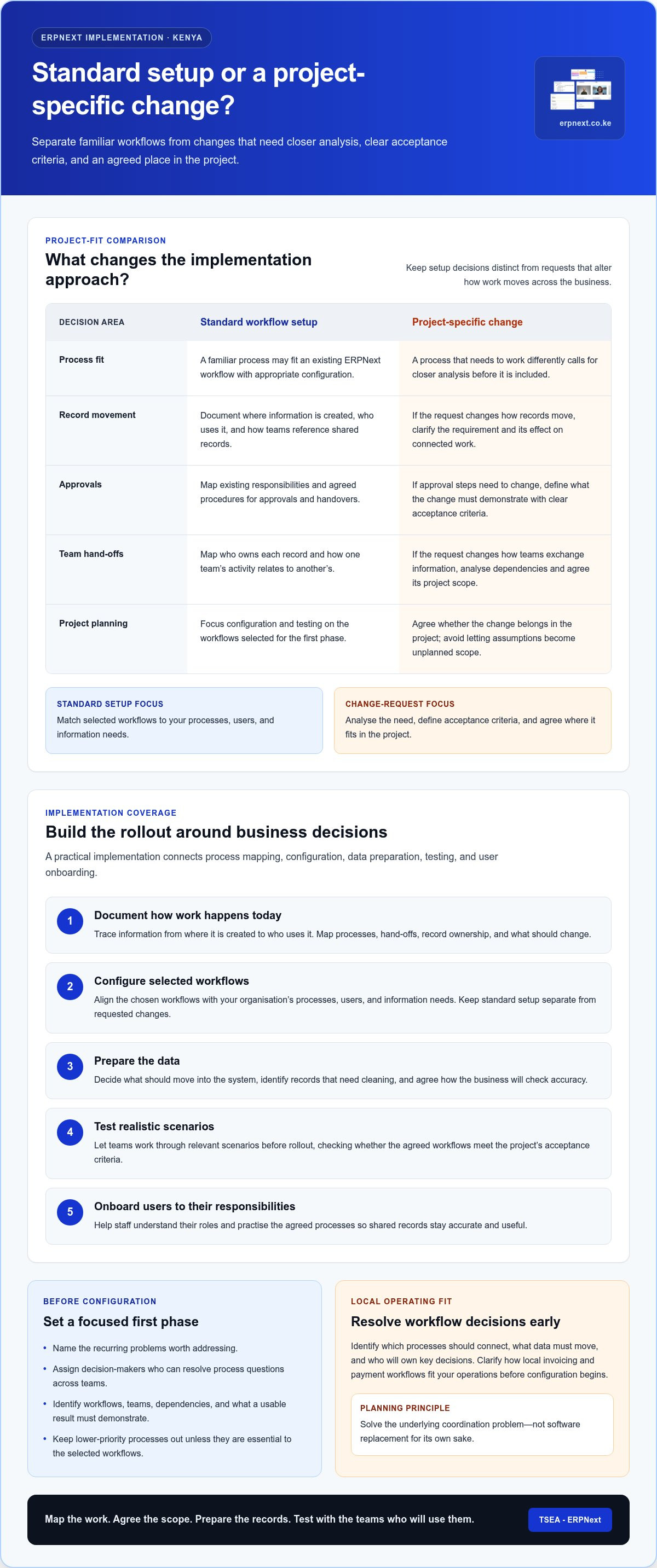
A solid ERPNext implementation is a sequence of business decisions, not just a configuration exercise. Start by documenting how work happens today, where information is created, who uses it, and what should change. That process map gives the project team a practical basis for deciding which standard ERPNext workflows fit and which requirements need project-specific analysis.
Configuration aligns selected workflows with your organisation’s processes, users, and information needs. Data preparation identifies what should move into the system, which records need cleaning, and how the business will check accuracy. Testing lets teams work through realistic scenarios before rollout, while user onboarding helps staff understand their responsibilities and practise the agreed processes.
Keep standard setup distinct from requested changes. A familiar process may fit existing ERPNext workflows with appropriate configuration. A request that changes how records move, approvals work, or teams exchange information needs closer analysis, clear acceptance criteria, and agreement on its place in the project. This distinction helps prevent assumptions from becoming unplanned scope.
How ERPNext modules connect business workflows
Finance, stock, sales, and purchasing records can be organised within one platform so teams have a shared operational reference. For example, a sales order may relate to stock availability and fulfilment, while the resulting transaction is also relevant to finance. The exact steps depend on the configured workflow, so map hand-offs and record ownership rather than assuming every process will connect automatically.
Industry needs shape that map. A retailer, manufacturer, pharmacy chain, or hospitality business may prioritise different processes. For a pharmacy chain, for example, clarify how teams handle stock and sales across branches, and what information managers need to review. Keep discovery focused on workflows in scope, and document specialist requirements separately for analysis.
How to assess Kenyan localisation requirements
For ERPNext implementation Kenya, localisation discovery should capture the actual documents, rules, and hand-offs your teams use. Record the current workflow and expected outcome for each area, then validate tax and invoicing requirements against current guidance before configuration. ERP software alone doesn’t establish compliance.
- Invoicing: Document how invoices are prepared, what information they need, who reviews them, and how corrections are handled.
- Tax: List the tax treatments and reporting outputs relevant to your business, then validate them against current KRA requirements.
- eTIMS: Identify how electronic invoicing fits the business’s process and validate applicable KRA and eTIMS workflow requirements before specifying a system change.
- Payments: Map how cash, bank, mobile, and other payment records are received, matched, and reconciled, including who resolves differences.
- Reporting: Specify the reports teams need, their source records, review frequency, and accountable owners.
Turn these findings into a requirements register with an owner, priority, and acceptance test for each item. This gives your team a grounded basis for reviewing ERPNext fit and project-specific needs. To explore how the platform could support your business, see ERPNext solution planning.
How to Compare ERPNext Implementation Approaches and Project Fit
Two ERPNext proposals can use the same platform yet deliver very different projects. Compare the work behind the offer, not just the feature list. For ERPNext implementation Kenya, a strong plan connects business priorities to clear deliverables, named decision-makers, dependencies, and evidence that each stage is ready to move forward.
Use this framework to assess whether the proposed approach makes essential work visible:
| Workstream | What the plan should explain | Fit check |
|---|---|---|
| Process discovery | Which workflows are mapped and how requirements are prioritised. | Are the processes tied to business priorities and owners? |
| Data migration | Which records are included, how they are prepared, and how accuracy is checked. | Is migration a defined workstream with business review? |
| Configuration | Which standard workflows are configured and which needs require analysis. | Are project-specific changes explained and approved? |
| Testing | Which scenarios are tested, by whom, and against what acceptance criteria. | Can teams demonstrate that key workflows work as intended? |
| Training | Which users need onboarding and how role-based tasks are practised. | Are adoption needs addressed before rollout? |
| Rollout | What moves into the initial release, what depends on it, and how readiness is decided. | Are responsibilities and go-live criteria explicit? |
Manage implementation risk through staged decisions, testing, and ownership, rather than assuming every issue can be predicted. A named business owner for each workflow can resolve questions promptly; documented dependencies make blockers visible; and measurable acceptance criteria give teams a shared way to judge readiness. Ask how scope changes are recorded, assessed, and approved so new requests don’t quietly displace priority work.
What should an ERPNext implementation plan make clear?
A useful plan turns requirements into prioritised workflows, deliverables, accountable owners, and review points. It should show where migration and testing sit in the schedule, rather than treating them as final checks. It should also explain how decisions are recorded and how proposed scope changes affect dependencies and acceptance criteria. Clear ownership helps business teams stay involved throughout the project.
How can you judge implementation value without a price comparison?
Compare the operational needs each plan is designed to support, then consider scope, dependencies, adoption, and future maintainability together. Separate the cost categories in your review: ERPNext software licensing, hosting, implementation work, and ongoing support are distinct items, and a proposal should make clear which it covers. Don’t assume a quoted project total includes every category.
Estimate return on investment using your own assumptions, such as staff time spent on repeated tasks or delays caused by manual hand-offs. Record the baseline, the expected change, and who will measure it after rollout. Treat the result as a business-specific estimate, not a promised outcome. This gives decision-makers a more grounded comparison than broad savings claims.
Prepare Your Team, Data, and Workflows for an ERPNext Rollout
A smooth rollout depends on decisions your team makes before launch, not just system setup. For ERPNext implementation Kenya, prepare in a clear sequence, keep the first release focused on high-value workflows, and agree how you’ll judge whether the change is working.
- Align leaders on priorities. Agree which operational problems the rollout should address and what the first phase will include. Set boundaries early so lower-priority requests don’t crowd out essential work.
- Assign process owners. Name a decision-maker for each workflow, such as sales order handling, stock updates, or purchasing approvals. Owners should be able to resolve conflicting requirements, approve decisions, and explain exceptions.
- Rank workflows and dependencies. Identify which processes matter most, what must happen first, and which teams rely on each step. Choose a starting scope that’s valuable but manageable.
- Prepare business data. Assign owners to key records and have them identify duplicates, incomplete entries, outdated information, and inconsistent naming. Agree which data is needed for the first phase and who will check it before migration.
- Test real work scenarios. Ask users to run representative tasks from beginning to end, including common exceptions, approvals, and hand-offs. Record issues, assign owners, and retest changes before teams rely on the new workflow.
- Train by role. Prepare practice activities around what each team member will actually do. Give users a clear way to report confusion or workflow problems, and make sure feedback reaches someone empowered to act.
- Review after launch. Track agreed measures, discuss what’s working and where work is getting stuck, then prioritise adjustments for the next phase.
Which decisions should leaders make before configuration?
Leaders should name accountable owners, agree how workflow conflicts will be resolved, and set a clear path for approving changes. Rank requirements by operational value, dependencies, and readiness: a process with clean data and an available owner may be a stronger first-phase candidate than a broader workflow with unresolved decisions. Document how teams will handle exceptions so staff aren’t forced to invent their own workarounds.
How can teams reduce disruption during rollout?
Test actual business scenarios before go-live, and schedule user participation so testing doesn’t become a last-minute task. Prepare role-based training that reflects configured processes, then keep a visible channel for feedback and issue ownership. Where appropriate, adopt workflows in phases rather than switching every team at once.
Set KPI baselines before launch. For example, record current reporting turnaround, the frequency of inaccurate or incomplete records, and how consistently teams follow the agreed process. Choose a clear measurement method and review cadence for each. Comparing results with those baselines gives leaders a grounded view of adoption and areas that need attention, without assuming the rollout will produce a particular result.
To explore a rollout shaped around your priorities, plan your ERPNext implementation with a focused scope, clear ownership, and practical readiness measures.
Move Forward with ERPNext Implementation in Kenya with TSEA
The right ERPNext project begins with your operating priorities, not a one-size-fits-all template. TSEA provides ERPNext implementation and an all-in-one business management platform for organisations in Kenya and worldwide, with solution areas spanning multiple industries and business functions. TSEA reports more than 250 satisfied customers worldwide, a useful point of reference as you consider how to shape your own project.
For ERPNext implementation Kenya, match the platform’s role to the workflows your organisation needs to manage. Define what the first phase should address, which teams need to participate, and what a successful working process would look like for your business. That gives the project discussion a clear foundation without assuming every organisation needs the same configuration or rollout.
Where TSEA’s ERPNext solution can fit
TSEA’s solution areas include pharmacy chain management, hospitality, manufacturing, retail, and education. The broader range also includes agriculture, aggregated payments, B2B marketing, call centers, and car repair management. These examples reflect varied operating models, from managing activity across a pharmacy chain to coordinating work in hospitality or manufacturing. The right starting point is the processes your organisation needs to connect, not a feature list assumed to suit every industry.
Bring forward the workflows that matter most to your teams and explain how they relate to your business priorities. TSEA can provide ERPNext implementation around those needs, with scope and decisions grounded in your operations rather than generic expectations.
What to bring into an ERPNext implementation conversation
Prepare a concise picture of how work currently happens. Specific examples help turn broad challenges into useful project questions. Consider bringing:
- Operational priorities: The problems you want to address first and why they matter to the business.
- Teams and workflows: The people involved, hand-offs between them, and where decisions or approvals happen.
- Current systems and data: The tools and sources teams rely on, the records they maintain, and any known data quality concerns.
- Reporting needs: The information leaders and teams use, how they access it, and where delays or inconsistencies occur.
- Implementation goals: The outcomes you want to assess, the workflows in scope, and the criteria you’ll use to review progress.
These details help TSEA understand your operating context and discuss a project scope aligned with your priorities. They also give your internal team a shared starting point for decisions about workflow, ownership, and rollout goals.
Ready to explore how ERPNext can fit your organisation? Discuss your ERPNext implementation with TSEA and bring your priority workflows, current systems, and business goals to the conversation.
Turn Your ERPNext Plans into a Clear Next Step
The next step doesn’t need to be a full technical blueprint. Start with a short decision brief: name one operational challenge worth addressing, the teams affected, and the change you want to evaluate. This gives your leadership team a useful starting point for prioritising a project and keeps the conversation anchored in real business needs.
For ERPNext implementation Kenya, a focused business-fit discussion connects those priorities to a practical project direction. Bring the workflows you want to explore, the systems and data your teams rely on, and any key decisions that still need an owner. From there, you can shape the discussion around your organisation’s goals and define a sensible path forward.
Discuss your ERPNext implementation with TSEA and take the first step toward a project shaped around how your business operates.
Frequently Asked Questions
How long does ERPNext implementation take in Kenya?
ERPNext implementation in Kenya has no fixed duration; the project plan depends on its scope and readiness. A focused rollout with agreed workflows and well-prepared records differs from a programme involving complex processes or integrations. Use a phased plan that shows dependencies, testing, and decision points. Another organisation’s timeline is a reference, not a reliable schedule for your business.
How much does ERPNext implementation cost in Kenya?
There’s no single implementation price that applies to every business. The investment depends on the work defined, including data migration, configuration, integrations, training, and project scope. Hosting and ongoing support may be separate expenses. Compare proposals by checking which deliverables and operational needs they cover, what assumptions they rely on, and which recurring costs sit outside the implementation work. Avoid judging fit by a headline figure alone.
Can ERPNext work for a business with multiple branches?
ERPNext can be assessed for organisations coordinating processes across branches, but the design should reflect how each branch operates. For example, clarify whether stock is managed locally, transferred between branches, or reported centrally, and how staff responsibilities differ. Map shared processes alongside legitimate branch variations before configuration. This helps define how records, permissions, transactions, and consolidated reports should work for your operating model.
Does ERPNext support KRA and eTIMS workflows?
Validate your required KRA and eTIMS workflows against current official requirements; don’t assume general accounting capability establishes compliance. Document how invoices are created, reviewed, corrected, and reported in your business, then include those scenarios in project testing and sign-off. Keep a record of applicable requirements and the test evidence your team uses to assess whether the configured workflow meets its needs.
Can we keep using existing software during an ERPNext rollout?
Yes, a planned transition can allow teams to prepare records and test new processes before changing live work. For each process, define which system is the source of truth during the transition, who handles updates, and how differences are reconciled. Set a clear cutover point and criteria for retiring the old workflow. Without those controls, parallel entry can leave teams with conflicting records.
What should we prepare before an ERPNext implementation discussion?
Bring a short, practical outline of the business issue you want to address, the teams affected, and one or two examples of where work gets delayed or duplicated. Note the software and data sources involved, reports people rely on, and any exceptions that complicate the process. You don’t need a finished technical specification. Clear examples help turn the first conversation into useful project questions.
Can ERPNext be customised for our business processes?
Project-specific customisation can be considered after assessing how your process maps to ERPNext and whether configuration may meet the need. Describe the business reason behind each requested change, who uses it, and what happens if it isn’t addressed. Then weigh its operational value against complexity and future maintenance. Separating essential requirements from preferences helps keep decisions focused on the work your business needs to support.


