
Cold-chain oversight is jurisdiction-specific: Kenyan operators must follow the national requirements applicable to medicines and their distribution, while pharmaceutical companies also use FDA and EMA guidance for cold-chain compliance. The FDA’s jurisdiction is primarily the United States and Puerto Rico, so it isn’t Kenya’s national regulator. Effective cold chain pharmaceutical inventory tracking also depends on keeping products within their required conditions; medicines that need refrigeration are commonly stored between 2°C and 8°C.
Temperature control is essential, but reliable records of storage, handling and transport help teams spot problems, limit avoidable waste and support an effective recall. Manual logs are vulnerable to human error, while digital monitoring can create a temperature record for each shipment and make exceptions easier to identify.
This article explains how oversight works, why monitoring matters and how inventory tracking can connect with wider business systems. A pharmaceutical cold-chain case study also shows how greater visibility can support audit preparation and help teams understand where a shipment deviated from plan.
Key Takeaways
- Compare manual, standalone and integrated monitoring to understand how each approach captures temperature data and supports audit-ready records.
- Separate the role of regulators from operational responsibilities, then see how shipment temperature and location visibility can help teams respond to deviations.
- Use inventory, expiry and traceability records to identify at-risk stock sooner and make recall execution more targeted.
- Connect monitoring data with ERP, warehouse and serialization systems to link product conditions with inventory and shipment records.
- Explore how a pharmaceutical cold-chain case study illustrates the potential value of better visibility for audit preparation and shipment oversight.
Why Is Cold Chain Monitoring So Important in Pharma?
Monitoring links a medicine’s required storage conditions with records teams can use during audits, stock decisions and shipment reviews. For refrigerated products such as insulin, the commonly cited range is 2°C to 8°C.
Compliance Monitoring
Pharmaceutical cold-chain monitoring records temperatures during storage and transport, documenting how medicines were handled. These records matter when an audit or temperature excursion requires staff to assess affected stock rather than rely on memory. Continuous digital logs can capture readings for each shipment, while manual logging can introduce human error. Standard operating procedures, staff training and regular audits help make record-keeping consistent.
Before relying on a system, test its sensors and alarms, document the checks, and train staff to record and escalate deviations. Keep records secure and traceable so reviewers can identify changes or missing readings.
Warehouse and Cold Room Monitoring
Stationary monitoring continuously tracks temperature in fixed locations such as warehouses, cold rooms, refrigerators and freezers. Sensor placement matters: readings should reflect the medicines’ storage conditions, not simply a convenient spot near a door or cooling unit. Teams can review trends to identify recurring fluctuations and investigate equipment or handling patterns before more stock is affected.
For example, a cold room log can show whether temperature shifts coincide with frequent door openings. Remote access, programmable alarms and automated reports can help staff see those changes and preserve a digital record. The CDC recommends checking and recording vaccine refrigerator temperatures twice a day.
High-Risk Shipment Monitoring
Shipment monitoring tracks temperature-sensitive products as they move between facilities, transport vehicles and distributors. A digital logger can create a temperature record for each shipment, making it easier to identify when a deviation occurred and assess affected goods. This is especially relevant for products whose chemical structure can be compromised by heat or cold, including biologics, oncology drugs and certain eye drops.
Set the product’s required conditions before dispatch, assign responsibility for responding to alarms, and review readings at receipt. This links the shipment record to the receiving team’s decision to accept, isolate or investigate stock.
Tracking Systems and Implementation
The right system depends on scale and workflow. A pharmacy may use monitored refrigerators and digital logs, while hospitals and distributors may need connected sensors, remote access and shipment-level records. In Kenya, costs depend on sensor type, connectivity, storage sites and the scope of integration. Pricing depends on the specific requirements and is provided after a quote request.
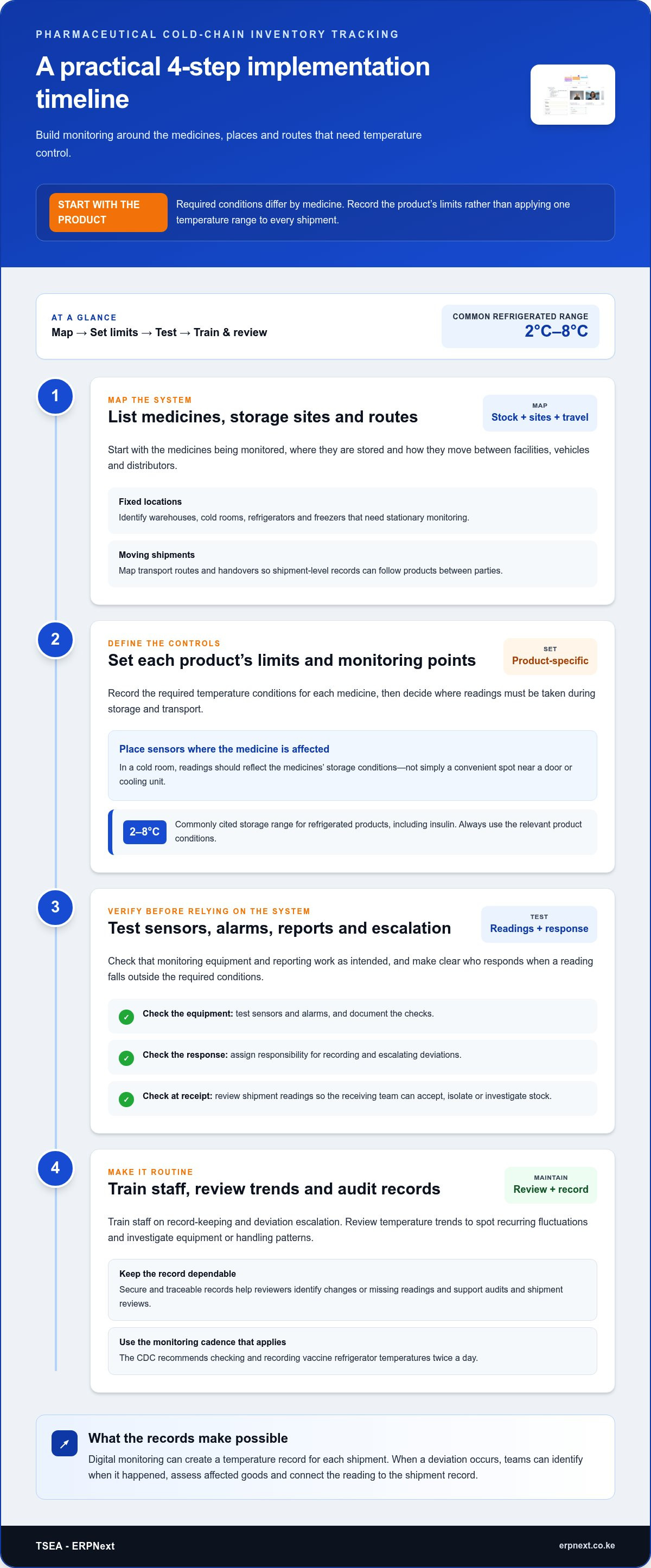
Implement pharmaceutical cold-chain inventory tracking in four practical steps:
- Map medicines, storage locations and transport routes.
- Set each product’s temperature limits and monitoring points.
- Test sensors, alarms, reports and escalation responsibilities.
- Train staff, review trends, and audit records regularly.
Who Regulates Cold Chain Logistics?
Responsibility depends on the shipment’s market and each party’s role. For medicines bound for Kenya, distinguish local obligations from overseas frameworks: the FDA’s jurisdiction is primarily the United States and Puerto Rico, while FDA and EMA guidance also informs practices followed by pharmaceutical companies. These frameworks should not be presented as Kenyan regulations.
The European Commission’s Good Distribution Practice guidelines for medicinal products were revised in 2013. Under its transport guidance, the supplying wholesale distributor is responsible for protecting medicines and maintaining acceptable temperature conditions during transport. That makes the handover between a distributor, carrier and receiving facility a key control point, not merely a dispatch record.
Product sensitivity determines the required temperature and humidity conditions. Certain COVID-19 vaccines require ultra-low storage temperatures around -70°C; Moderna and Pfizer vaccines are associated with transport temperatures of -20 and -70 degrees Celcius. Requirements differ by product, so logistics teams need the relevant product conditions recorded against each shipment, rather than applying one range to every medicine.
Real-time visibility combines a shipment’s location with its temperature readings. IoT monitoring can show teams where goods are and identify a deviation in transit, making it easier to coordinate a response or transfer stock before delivery. Analytics can reveal recurring route or handover patterns, while digital records connect each reading to the shipment and its custody history.
Temperature excursions raise product-quality concerns and can lead to stock loss or unreliable inventory records if affected units remain mixed with usable stock. Inaccurate records can also slow a recall when teams struggle to identify the relevant batch, location or recipients. For a vaccine shipment, a logged deviation should trigger a documented review and clear separation of affected inventory while its status is assessed.
Last-mile delivery deserves the same attention as long-haul transport. A shipment may pass between a distributor, carrier and facility, so teams need a visible location, condition record and assigned response at each handover. The Drug Supply Chain Security Act (DSCSA) requires end-to-end traceability in the United States, but it is not a Kenyan regulation. The European Commission’s transport guidance likewise places responsibility on the supplying wholesale distributor during transport.
For pharmacy groups, connecting shipment exceptions with stock records helps teams act on the same information across locations. Pharmacy Chain Management can support the wider inventory workflow alongside temperature-monitoring processes, keeping stock visibility connected to day-to-day operations.
Reducing product waste and improving recall execution
Product waste and recall delays often stem from gaps between medicine condition and inventory records. Connecting temperature history, product identity and stock movement gives teams a clearer basis for decisions.
Pharmaceutical cold chains rely on digital product identity, serialization, traceability, data integrity, transparency and waste management. These elements work together: temperature records describe product conditions, while batch and movement records show where affected units went. When records are separate, staff may need to reconcile shipment logs, packaging details and stock counts before isolating inventory.
Product Integrity and Patient Safety
Product integrity means preserving a medicine’s identity, condition and usability through storage and distribution. It matters because heat or cold can compromise products with sensitive chemical structures, affecting whether stock remains suitable for patients.
For example, teams can link a recorded excursion to the relevant batch and hold those units separately while reviewing their status. Clear packaging identifiers and continuous condition records help prevent affected stock from being mistaken for unaffected inventory.
Traceability and Recall Execution
Traceability links a medicine’s identity to its batch, location and movement through the supply chain. During a recall, these links help teams identify affected units, locate stock across facilities and record what has been isolated or removed.
Serialization and accurate inventory updates make the search more targeted. A recall team can match the product identifier on packaging to stock and distribution records, then document each action. This reduces reliance on broad manual searches and supports a clear account of where units went.
Expiry and Pilferage
Expiry control uses dated stock records to identify medicines nearing the end of their usable period. Pilferage control compares recorded stock with physical inventory. Both matter: expired or missing units can reduce availability and obscure the true quantity on hand.
The CDC vaccine inventory guidance recommends checking medication and diluent expiration dates once a week. Over 50% of pharmaceutical manufacturers face a 1% sales loss due to pilferage and expiry. Linking expiry dates and stock movements helps teams spot discrepancies and prioritize action.
For a practical review, follow the product from receipt to final disposition. Match packaging identifiers to batch records, compare physical counts with system balances, and flag stock affected by temperature deviations. Then document decisions, including quarantine, recall action or approved release, so later reviews can follow the same evidence trail.
- Review expiry dates weekly and flag near-expiry stock.
- Reconcile physical counts with recorded inventory.
- Link batch identifiers to shipment and location records.
- Document each recall or stock-disposition decision.
Integrating cold chain platforms with ERP, WMS and serialization systems
Integration connects temperature and shipment events with the business records used to manage stock. An ERP can hold purchasing and inventory data, a warehouse management system (WMS) can track warehouse movements, and serialization records can link products to unique identities. Together, these systems give teams a more complete view of biologics and other temperature-sensitive shipments.
Linking systems and records
Start by agreeing which system owns each data point. For example, the ERP may hold item and batch details, the WMS may record a pallet’s warehouse location, and the monitoring platform may capture shipment conditions. A shared product or shipment identifier lets these records connect without requiring staff to match separate spreadsheets.
When a sensor reports a temperature deviation, integration can link the event to the relevant shipment, batch and inventory status. Staff can then review it alongside receiving, storage or dispatch information. This improves product traceability while preserving the integrity of the original sensor record.
Planning for scale and data integrity
Map the data flow before connecting systems: identify the product identifier, batch, shipment, location, timestamp and condition record. Define how each platform sends and receives updates, and how it handles duplicate, delayed or missing messages. A test shipment can reveal mismatched identifiers before the workflow expands across warehouses or global supply routes.
Scalable integration also needs clear exception handling. If a WMS records a receipt before monitoring data arrives, the record should remain distinguishable from one with complete condition data. Teams can document responsibility for reviewing gaps, correcting mismatches and retaining an auditable history without overwriting the source event.
Connecting packaging and monitoring data
Packaging protects products during transport, while monitoring records the conditions experienced in transit. For a biologics shipment, teams can associate the packaging configuration and shipment identifier with sensor readings, route details and receipt records. This helps reviewers assess the shipment as a connected chain of evidence rather than as separate files.
Treat packaging validation as a documented process tied to the intended product and transport conditions. Keep the relevant packaging configuration, shipment records and temperature data accessible together. If a shipment uses a different packaging setup, staff can record that change rather than assume every container performed identically.
Use a controlled rollout to build confidence in the data exchange:
- Map ERP, WMS, serialization and monitoring records to shared identifiers.
- Test ordinary events and exceptions with sample shipments.
- Review data integrity, timestamps and missing-message handling.
- Train staff to investigate alerts and record decisions.
- Expand to additional products, facilities or routes after review.
This approach connects shipment visibility with inventory operations while keeping system roles clear. Teams can scale from one warehouse workflow to wider distribution without losing the link between product identity, location and condition history.
Pharmaceutical cold chain case study
A biopharmaceutical company used real-time location and inventory tracking for plasma containers, a sensitive product moving through complex logistics. According to the case account, this visibility helped the company eliminate FDA infractions. The example highlights a practical challenge: teams need to connect product location, inventory status and shipment conditions before problems become difficult to investigate.
The company achieved 100 percent real-time visibility into plasma-container location and inventory. That gave staff a current view of where containers were, alongside their inventory status. A platform could also identify current and past locations of a product or pallet, then pinpoint when and where it deviated from its original plan. Those details help teams focus an investigation on a specific movement or handover.
Audit preparation changed too. One pharmaceutical manufacturer reduced preparation time from days to minutes after cold-chain integration. When records are gathered digitally, staff spend less time collecting separate logs and more time reviewing the evidence. This matters for manufacturing and distribution teams balancing audit demands with routine inventory and shipment processes.
Another reported implementation reduced temperature excursions across thousands of batches. The account describes a staged approach: a pharmaceutical team began monitoring on a single European shipping lane, demonstrated return on investment, then scaled globally. Starting with a defined lane gives teams a focused way to test sensors, alert handling and data flows before expanding to more routes.
Monitoring can cover more than temperature. The described solution tracked shipment conditions including light, humidity, tilt and vibration. IoT edge computing can also monitor sensors and devices on refrigerators, storage containers and boxes inside trucks or vans. The relevant signals depend on the product and transport process: biologics may need a different review plan from less temperature-sensitive stock.
The case also shows why timing matters. Without a digital visibility platform, companies may wait up to seven days after arrival for temperature logs to be downloaded and returned. Faster access can bring condition data into shipment reviews sooner, supporting more timely decisions about stock status. IoT edge systems can also predict device or equipment failure and recommend a resiliency plan, helping teams address operational challenges before disruptions spread.
For a practical rollout, select one route, define the product and shipment records to connect, then review alert and audit workflows before expanding. Use ERPNext for connected inventory workflows to strengthen visibility across business operations.
TSEA - ERPNext: ERPNext
TSEA - ERPNext is a natural next step for pharmacy teams looking to connect inventory operations with broader business management. ERPNext and Pharmacy Chain Management support organizations coordinating stock across pharmacy locations and aligning operational records with wider workflows.
Cold-chain monitoring still depends on appropriate sensors, processes and staff responses. A business management platform supports the wider operational context, while teams define how monitoring records relate to inventory decisions, shipment reviews and affected stock. Consider this approach when disconnected records make it harder to coordinate pharmacy operations across locations.
Explore how ERPNext and Pharmacy Chain Management fit your operational priorities. Contact TSEA - ERPNext or visit erpnext.co.ke.
Build the Next Phase of Cold-Chain Visibility
Make the next step a practical alignment exercise: identify which inventory decisions need temperature, shipment and product records together. This gives your team a clearer starting point for evaluating how cold-chain pharmaceutical inventory tracking fits wider business workflows, without treating monitoring data as a separate operational island.
TSEA - ERPNext offers ERPNext, Pharmacy Chain Management and Hospitality. For a pharmacy business, Pharmacy Chain Management is the closest fit; ERPNext supports broader business management, while Hospitality serves a different operational context. Consider these offerings when planning how pharmacy operations and business processes should work together.
Bring your priorities into the conversation and explore a suitable path forward. Contact TSEA - ERPNext to discuss your business needs and take the next step with confidence.
Frequently Asked Questions
How does the pharmaceutical supply chain work?
The pharmaceutical supply chain moves medicines from manufacturers through distribution channels to pharmacies, hospitals and patients. Each handover connects a product with records about its identity, quantity, destination and handling. For a refrigerated medicine, the receiving facility can match delivery paperwork with the physical stock and its condition history. If a discrepancy appears, staff can isolate affected units while reconciling batch and inventory records.
What Are the Key Components of a Monitoring System?
A monitoring system combines a temperature sensor, a way to record readings, and software to review data and exceptions. Shipment setups may also use a location device to associate readings with a route or handover. RFID systems typically include a data-bearing tag, reader, antenna and processing software. The right combination depends on whether the priority is fixed storage, shipment visibility or linking product identity with recorded conditions.
What are Pharmaceutical Temperature Monitoring Requirements?
Monitoring should produce accurate, secure records showing how medicines were stored, handled and transported. A useful operating process defines who reviews readings, how staff record exceptions, and where supporting evidence is retained. For example, a receiving team can compare the shipment record with delivery time and product identifier before updating stock status. Procedures, trained staff and regular audits help ensure records are useful during reviews.
Which Pharma Products Need It?
Products with chemical structures that can be compromised by heat or cold need handling and monitoring suited to their sensitivity. Examples include insulin, biologics, oncology drugs and certain eye drops. The product’s required storage conditions determine what staff monitor and how they assess a deviation. A pharmacy receiving refrigerated insulin, for example, needs a clear record linking delivered stock to its storage and handling history.
What is cold chain pharmaceutical inventory tracking?
Cold-chain pharmaceutical inventory tracking connects medicine stock records with information about temperature-controlled storage and movement. It helps teams relate a product’s batch and location to its condition history, supporting more informed decisions about receiving, storing or isolating inventory. For example, if a shipment record shows an exception, staff can identify the associated stock instead of treating every item in the delivery as having the same status.
What temperature ranges are required for common pharmaceutical products?
Temperature requirements vary by medicine and should follow the product’s specified storage conditions. Insulin is commonly stored between 2°C and 8°C. Certain COVID-19 vaccines require ultra-low storage around -70°C, while the cited transport temperatures for Moderna and Pfizer vaccines are -20 and -70 degrees Celcius. These examples show why teams should connect each product record with its own handling conditions rather than apply one range across all stock.
What technologies track pharmaceutical inventory and temperature in real time?
Connected temperature sensors, digital data loggers, location technologies and RFID can support real-time visibility. A sensor captures conditions, while software associates readings with shipment or inventory records. RFID uses a tag, reader, antenna and processing software to transmit and handle tag data. The value comes from connecting these signals: teams can relate a product’s identity and location to its recorded temperature rather than viewing each data stream separately.
How do pharmacies and distributors monitor cold chain excursions?
Pharmacies and distributors monitor excursions by reviewing alerts and shipment records, identifying affected stock and documenting its status. For example, staff can hold a shipment separately when its condition history shows a deviation, then link the review to its product and batch records. Record who assessed the event, what evidence informed the decision, and how the inventory record changed. This creates a traceable account for later operational review.


