
Strong hospitality operations depend on more than good service. Teams also need a clear view of activity and performance. A hospitality business management system brings operational information together with financial records, helping managers monitor results, apply controls and maintain an audit trail.
That connection matters whether you manage a hotel, restaurant, event venue or another hospitality business. When operational and financial information is scattered across separate processes, it becomes harder to see how daily decisions affect the wider business.
This article explains what hospitality management involves, how venue data connects with financial systems, and how those links can support business benefits, stronger controls and clearer records. You’ll learn what a system can coordinate, where it can help, and how an ERP platform can support hospitality operations.
Key Takeaways
- Map how bookings, service activity and venue operations feed into financial records to see where disconnected information can slow decisions.
- Explore how coordinated availability, guest preferences and routine workflows can support smoother service and more informed planning.
- Use revenue, invoice and payment records to strengthen financial oversight and make transaction histories easier to follow.
- Consider whether ERPNext’s hospitality offering can help bring business management into a more connected operating picture.
Integrating venue data with financial systems
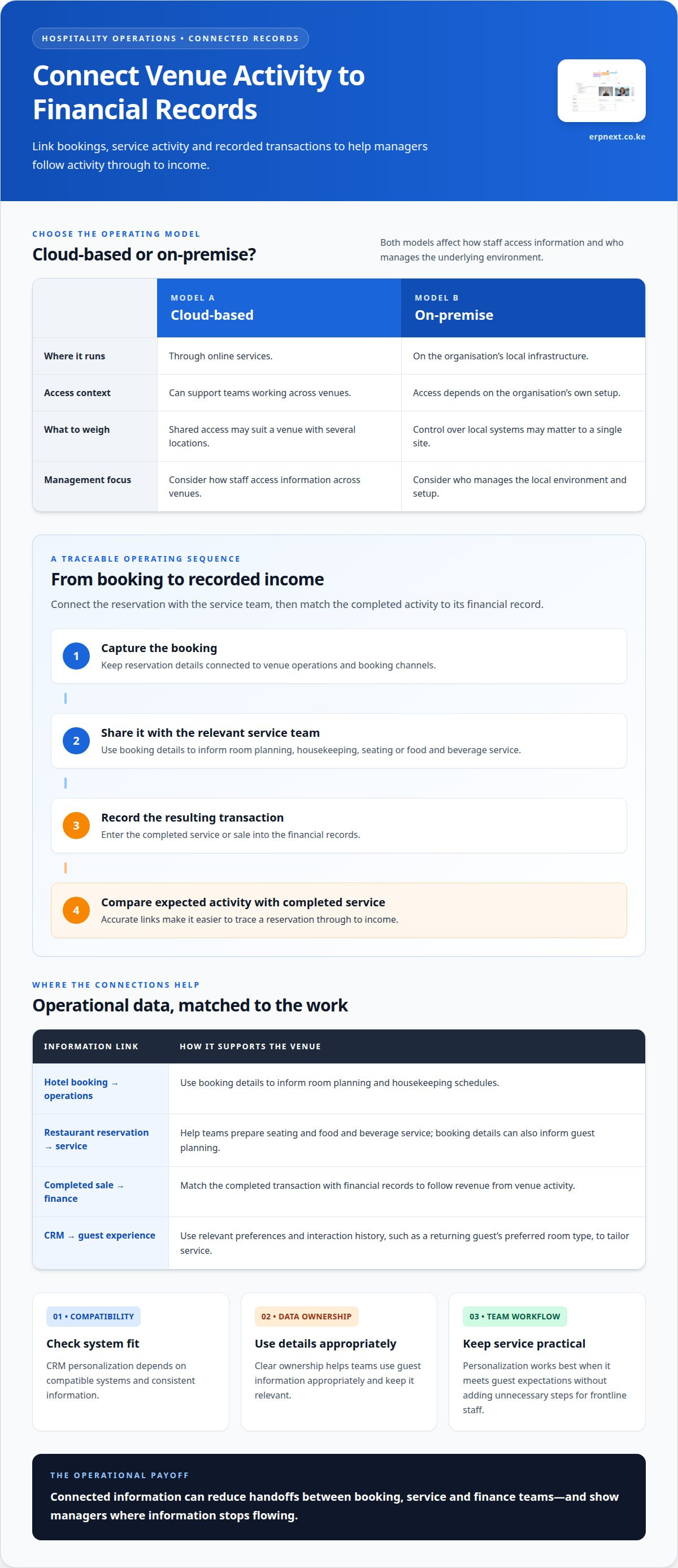
A hospitality business management system can connect venue operations, booking channels and CRM software, bringing room, table, event, and food and beverage activity into a shared operational view. Managers can compare reservations with service activity and recorded revenue. For example, restaurant booking details can inform guest planning, while the completed sale is entered into financial records. This makes it easier to trace a reservation through to income.
Cloud-based systems run through online services, while on-premise systems rely on an organisation’s local infrastructure. Cloud access can support teams working across venues; on-premise access depends on the organisation’s own setup. Each model affects how staff access information and who manages the underlying environment. A venue with several locations may value shared access, while a single site may prioritise control over its local systems.
Booking channel integration keeps reservation information connected to venue operations. A hotel can use booking details to inform room planning and housekeeping schedules, while restaurant reservations help teams prepare seating and food and beverage service. The practical sequence is straightforward: capture a booking, share it with the relevant service team, then record the resulting transaction. Accurate links make it easier to compare expected activity with completed service.
CRM integration adds guest preferences and interaction history to this picture. Staff can use relevant details, such as a returning guest’s preferred room type, to tailor service. This depends on compatible systems and consistent information. Clear ownership of guest data also helps teams use it appropriately. Personalization works best when the details collected meet real guest expectations without adding unnecessary steps for frontline staff.
- Connect reservations with housekeeping or table planning so teams can prepare for expected arrivals.
- Match completed service transactions with financial records to follow revenue from venue activity.
- Review CRM fields and booking information so personalized service uses relevant guest details.
These integrations can improve operational efficiency by reducing handoffs between booking, service and finance teams. They can also show managers where information stops flowing. For hospitality teams, that visibility supports better coordination and helps build practical experience in venue operations.
Business benefits of hospitality management
In hotels, resorts and restaurants, connected workflows can help teams act on service information. Real-time availability updates can help reduce overbooking, while guest records can support tailored recommendations. For example, knowing a returning guest’s room preference can help staff prepare a more personal welcome. The business benefit is a guest experience shaped by useful information rather than guesswork.
Choose a system by matching its functions to the venue’s daily work. A hotel may prioritize reservations, housekeeping and guest services; a restaurant may focus on food and beverage activity, staffing and customer service. Compare how each option supports management reporting, staff workflows and guest expectations. The right fit is the one that supports the venue’s actual service model.
There isn’t one system that suits every venue in Kenya’s hospitality industry. Hotels and lodges typically need accommodation workflows, while restaurants and resorts may prioritize food service, events or leisure operations. Compare systems by those capabilities rather than by popularity alone, then assess whether their functions fit the venue’s teams and guest experience.
Implement the chosen software by mapping current workflows first. Identify who records bookings, updates availability and handles daily service, then configure roles and information around those responsibilities. Train staff with familiar examples, such as changing a reservation or recording a guest preference. A staged rollout gives teams time to learn the digital process and helps leadership spot workflow gaps before wider adoption.
- Use availability updates to help teams coordinate reservations and reduce overbooking risks.
- Apply relevant guest preferences to make service more personal and consistent.
- Review whether the system supports the venue’s service priorities, staff workflows and management needs.
Digital tools can reduce reliance on paper-based processes and streamline routine work. Loyalty programme features can support rewards and incentives that encourage guest retention. Leadership should focus on the benefits that matter most to the venue, whether smoother service, more consistent customer care or clearer operational coordination. A hospitality business management system should support those goals with practical workflows teams can use every day.
Financial controls and audit trails
A financial control connects venue activity to a recorded transaction. Hospitality systems can track revenue, manage invoices and process payments. For example, a restaurant sale can be assigned to a food or beverage category, then reviewed against the recorded payment. This helps managers trace transactions from service through to financial reporting.
An audit trail records what changed, when it changed and which authorised user made the change. If a guest services team corrects an invoice, the record should preserve the adjustment and its reason. Managers can then review unusual discounts, voids or refunds instead of relying only on end-of-day totals. Clear user roles help limit who can approve sensitive changes.
For a Kenyan venue, assess whether the system supports records needed for applicable tax obligations and eTIMS invoicing workflows. Data protection controls should also limit access to guest information to staff who need it. Before implementation, map each requirement to a system process, such as invoice creation, record access and retention.
Payment support depends on available system integrations and the venue’s setup. List accepted methods, including mobile money and card payments, then map each method to its transaction record and reconciliation process. A tourism lodge, for example, may need to distinguish room revenue from restaurant payments while keeping each entry traceable.
- Assign access by role, such as cashier, supervisor and finance reviewer.
- Record reasons for invoice edits, refunds and discounts.
- Reconcile payment records with sales by venue and service category.
Security risks include unauthorised account access, excessive staff permissions and exposed guest records. Review login controls, user permissions, backup practices and incident procedures when selecting a system. Marketing records and guest service details also need careful access management. Defined review steps make responsibilities easier to teach in staff training, including to students entering hospitality roles.
Systems may support mobile money and card payments, depending on their integrations and the venue’s setup. Link each method to its transaction record and reconciliation process.
What is a hospitality business management system?
A hospitality business management system brings service workflows and management information into a coordinated platform. It can support operations across hotels, restaurants, resorts, events and leisure businesses, with functions varying by service model. A hotel may need room operations, while an event venue may organize event calendars and guest services. Meanwhile, hospitality venues running wellness or personal care amenities often benefit from specialized platforms such as Encore Salon & Spa Software to coordinate appointments and client records.
In hotel management, teams commonly coordinate front office, housekeeping, reservations and food and beverage. Hospitality managers may oversee daily operations, staffing, guest relations and financial performance. A shared system can give teams a clearer view of their responsibilities. For example, a calendar overview can help housekeeping plan room preparation around scheduled arrivals.
Routine task support is another practical function. A system can help schedule housekeeping and display work in a calendar. Guest-facing tools may support mobile check-in and check-out and allow staff to record room preferences. These features connect staff tasks with the guest journey, from preparing a room to completing departure.
- Accommodation: coordinate reservations, front-office tasks and housekeeping schedules.
- Food and beverage: organize service activity alongside other venue operations.
- Events and leisure: use calendars to coordinate schedules and service teams.
- Guest services: record preferences and support check-in or check-out workflows.
A system’s value depends on how well its functions match the venue. A restaurant focused on food service needs a different setup from a lodge managing rooms and guest arrivals. Managers can map the daily tasks each team owns, then identify what information needs to move between those tasks. This helps distinguish an operational platform from a collection of separate tools.
For a connected approach to hospitality operations, explore hospitality management options and consider how they align with your venue’s workflows.
TSEA - ERPNext: ERPNext
TSEA offers ERPNext and Hospitality for businesses seeking a more coordinated approach to hospitality management. ERPNext is an all-in-one business management platform, making it a relevant option when a venue wants to bring business processes together. The right fit depends on the venue’s operations and the workflows it needs to support, such as reservations, guest services or financial oversight.
Turn to TSEA - ERPNext when you’re assessing how ERPNext could support your hospitality business. The discussion can focus on your operating model, current processes and the business information you need to manage. This keeps the conversation grounded in practical requirements rather than assumptions about what every venue needs.
To discuss ERPNext for your hospitality business, contact TSEA - ERPNext.
Make your next hospitality decision count
Before changing tools, choose an operational priority your team wants to improve, such as clearer management visibility or smoother coordination between departments. Use that priority to guide discussions about the workflows a hospitality business management system should support. A focused starting point gives managers and frontline staff a shared purpose, while leaving room to expand as the venue’s needs evolve.
TSEA - ERPNext offers ERPNext and Hospitality for businesses considering an ERP platform for hospitality operations. Its Pharmacy Chain Management offering serves a separate business need. If you’re ready to discuss how ERPNext could fit your venue’s processes, contact TSEA - ERPNext. Bring your main operational priority into that conversation, and use it to shape a practical next step. Stronger systems begin with a clear business goal and a team ready to move forward.
Frequently Asked Questions
What Does Hospitality Management Mean in Practice?
Hospitality management means coordinating people, services and business decisions around a guest’s visit. At an event venue, for example, the event schedule informs room setup, staff assignments and guest communications. A manager can then review service feedback and operational results to identify what needs attention before the next event. It connects the guest-facing experience with the planning behind it.
What features should a hotel management system include?
A hotel system should support the tasks staff handle throughout a guest’s stay. Useful functions can include room-status updates, reservation records, rate and availability management, maintenance requests, staff permissions and operational reports. For example, a maintenance request linked to a room helps staff track the issue and coordinate its resolution before assigning the room to another guest.
What is the difference between a hotel PMS, POS, and channel manager?
A hotel property management system (PMS) organizes accommodation records and front-office work. A point-of-sale (POS) system records sales, such as a restaurant meal charged to a guest’s stay. A channel manager distributes room availability and rates across booking channels, helping keep reservation information aligned. These tools have distinct roles, even when integrations allow information to move between them.


